Do Asheville Metal Roofs Really Need Snow Guards?
RoofingBaker Home Exteriors
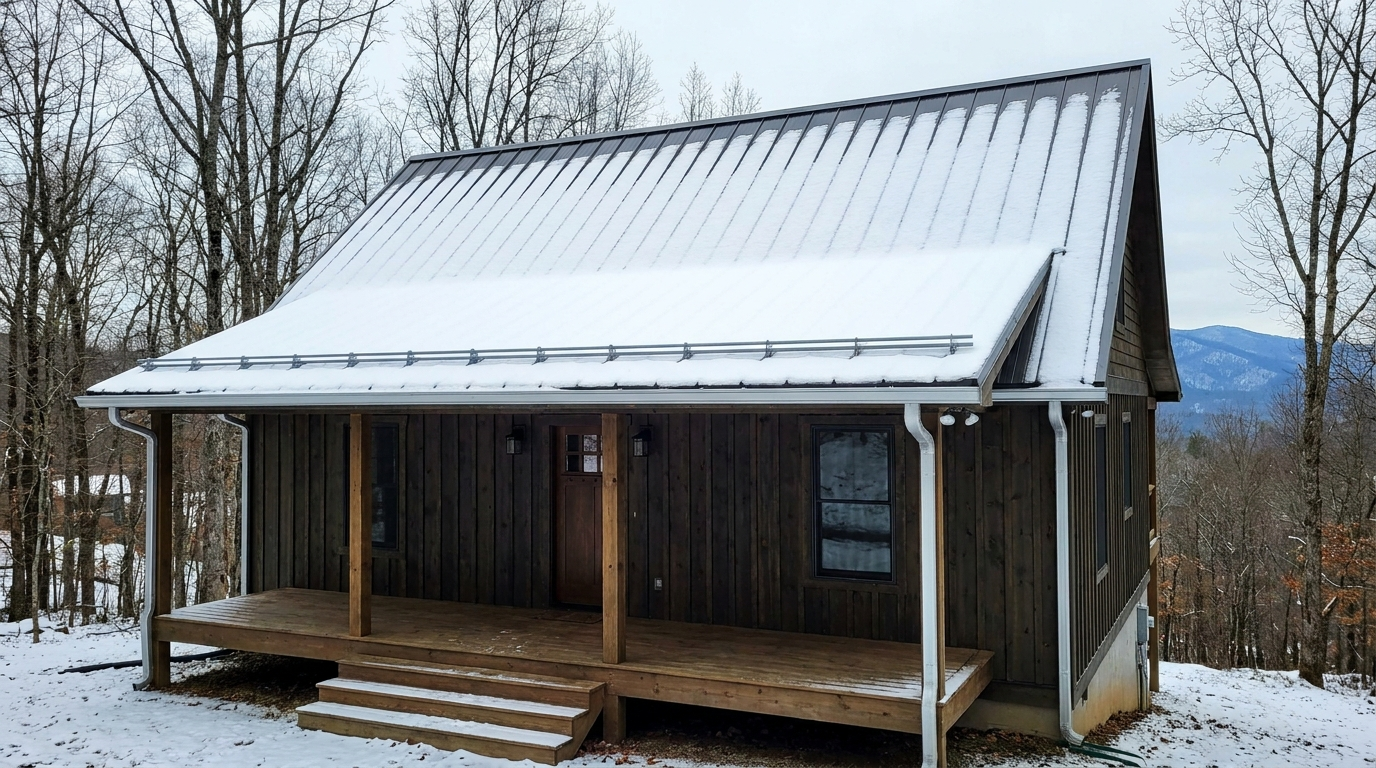
A metal roof sheds snow. Most of the time that's a good thing, right up until a slope drops its whole load at once onto your front steps, your car or your gutters. If you live under a metal roof in Asheville, or you're weighing metal roofing for your home, snow guards are the obvious next question, and most of the top search results for metal roof snow guards come from companies that sell them. We've written this guide from the other end: how much snow an Asheville house actually sees and what sits below each roof edge, then where guards go, which types hold up, what they cost and how they sit with your roof's warranty.
Which Asheville Metal Roofs Actually Need Snow Guards?
The ones that shed snow onto something. A slope that empties over your entry, a walkway, a deck, the spot where you park, an outdoor heat pump or a lower roof is where a sliding snowpack can do harm. A slope that drops its snow into open yard has nothing below it to break.
On the code question, SnoBlox-Snojax, a snow guard maker, says on its metal roof snow guards page that building codes in most areas of the United States generally don't require snow guards, though some places, particularly those with high snowfall or unusual roof conditions, may have requirements, and it tells owners to check their local codes.
Asheville's snowfall is the other half of the answer. The State Climate Office of North Carolina puts Asheville's average annual snowfall at 10.2 inches for the 1991 to 2020 period.
Height above sea level changes the picture. NOAA's North Carolina State Climate Summary 2022 puts the statewide average at around 5 inches of snow a year and notes that the higher elevations of the Appalachian Mountains can receive up to 100 inches. A house high on a ridge outside the city can sit in a snowier climate than the Asheville average suggests.
A small total doesn't make a slide harmless, though. The Metal Roofing Alliance, a metal roofing industry group, warns in its winter guidance that even a few inches of ice and snow on a roof can cause a heavy, sudden slide, especially on steep pitches. We think the Asheville numbers support a plain conclusion: snow guards are optional on a lot of metal roofs here, and the case for them rests on what sits below each slope and how high the house sits.
What Can Sliding Snow Damage Below a Metal Roof in Asheville?
Anything under the eave when the snowpack lets go. A research abstract in the National Roofing Contractors Association's guidelines library, drawn from a 1996 publication by the U.S. Army Cold Regions Research and Engineering Laboratory, puts the stakes plainly: sliding snow and ice can damage property, kill people and overload lower roofs.
Around a house, that list turns into specifics: front steps and walkways, a deck or patio, cars parked along the drip line, an outdoor heat pump, and any porch or addition roof that sits below a larger slope and takes whatever that slope drops. People belong at the top of the list, because a slope above the front door sheds right where everyone in the house walks.
Gutters sit directly in the path. In a 2022 r/asheville thread started by a homeowner looking for someone to install snow guards, one resident replied that ice had torn their gutters off before they had guards and hadn't since. One household's experience isn't a study, but it's the kind of damage that turns a thaw into a repair bill.
If you decide to let a slope shed, it helps to keep people, cars and outdoor furniture out from under its edge while there's snow on the roof. Ice dams are a separate winter problem, with meltwater refreezing at a cold eave and backing up rather than snow sliding off, and our guide to how gutters protect your roof, siding and foundation covers them.
How Do You Tell Where Snow Guards Belong on an Asheville Home?
Start on the ground, one slope at a time. There's no need to climb onto the roof or a ladder for this part. Each roof plane sheds toward its lower edge, so trace every slope down and note what sits beneath that edge: a door, steps, a walkway, a deck, the driveway, equipment, a lower roof, a gutter run you'd rather keep. If no slope sheds over anything on that list, sliding snow has little to damage.
Where a house does need guards, the guidance on placement is broader than a patch over the door. The Metal Roofing Alliance's winter guidance says that, as a general guideline, the entire eave line of a building should be protected rather than one isolated area, and it warns against shortcuts such as guards only above doorways, which it says can make snow shedding even more unpredictable.
A 2024 r/Roofing thread titled "Snow guard ripped standing seam" shows what that shortcut cost one owner. The guards sat only over the door, the owner explained, and when the rest of the roof slid, it ripped the guards at the edge of that patch.
Rows and spacing come from a layout, not a rule of thumb. The Metal Roofing Alliance lists what drives the layout: the roof's profile, material and slope, the width of the panels, the rafter length from eave to ridge and the length of the eaves. It also mentions S-5!'s online snow guard calculator, and it says snow guard placement should be handled by an experienced system designer or installer.
Do Pad or Rail Snow Guards Last Longer on Standing Seam Roofs?
The attachment decides it more than the shape. Rocky Mountain Snow Guards' introduction to metal roof snow guards notes that a bar-style guard can't be glued at all, because the loads on its brackets are too great for adhesive alone, so a rail is always clamped or fastened. A pad can be clamped to the seam or glued to the panel.
The Metal Roofing Alliance sets the longevity bar in its winter guidance: primary snow guard components should be made of noncorrosive metal with a life expectancy at least equal to the roof's, and plastic components, adhered products and anything not mechanically fastened don't offer long-lasting protection. On standing seam, a mechanical attachment that leaves the panel intact means a clamp.
SnoBlox-Snojax, which sells glue-down pads, makes the case for them. Its guide to snow guards on standing seam roofs says its clear polycarbonate pads, glued to the flat of the panel, form a permanent bond with its adhesive, and the same guide shows the catch: it says that adhesive needs about 28 days at 50°F to reach a full cure. In Asheville, that makes a glued pad a warm-weather job, not something to add once snow is in the forecast.
Between rails and metal guards clamped seam by seam, appearance is one practical difference. Rocky Mountain Snow Guards' introduction notes that many bars can carry a strip of the roof's own metal so they match its color, where individual guards sit on the roof as a pattern of separate pieces.
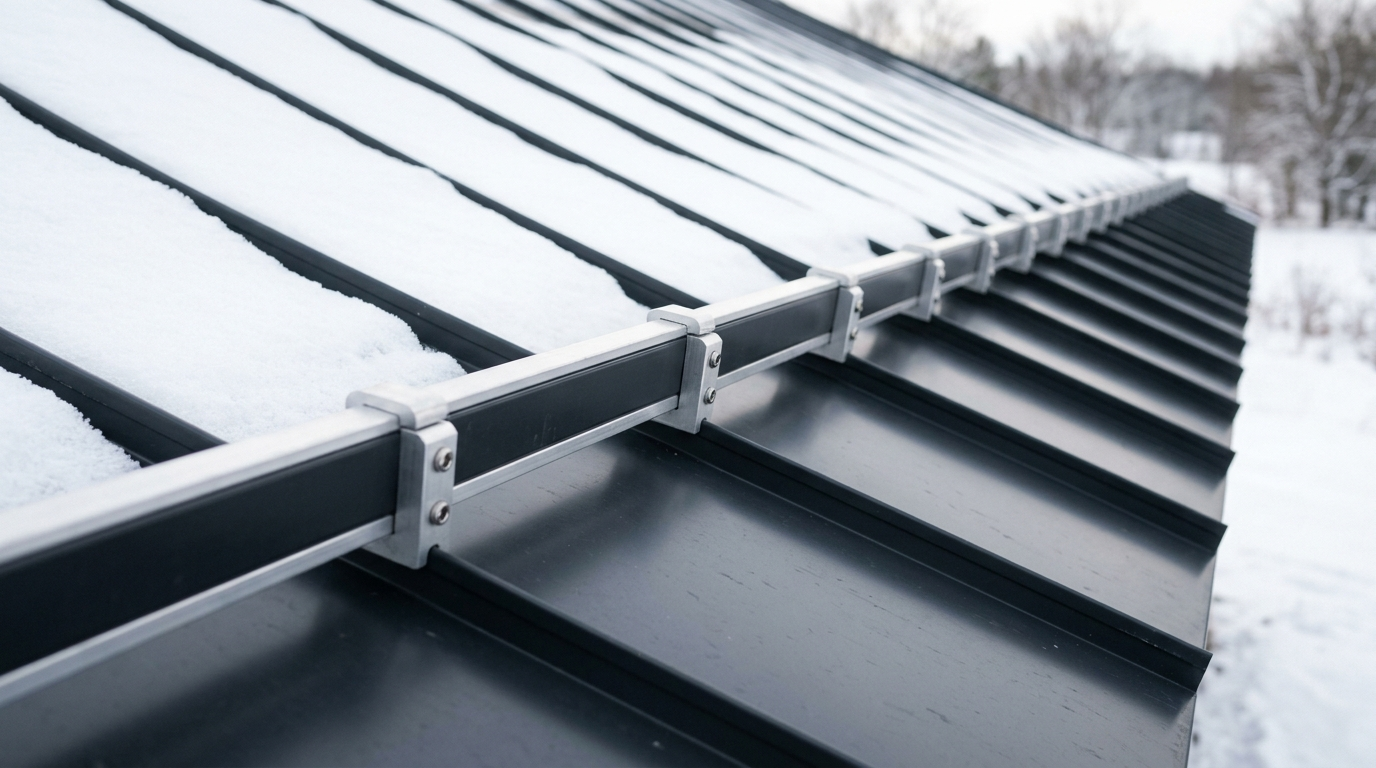
Screws through the panel are a different matter on standing seam, and the warranty section below covers what SnoBlox-Snojax and S-5! say about them.
Which Snow Guards Fit an Asheville Metal Shingle Roof Without Damage?
Metal shingles take seam clamps off the table, because stamped shake and slate profiles have no standing seam to grip. Rocky Mountain Snow Guards' introduction says individual guards can go on most metal shingles, and it describes two ways such guards attach: glued down with liquid adhesive or tape, or screwed through the metal into the wood deck below. On a shingle roof, a screw is a hole in the roof surface, so the sealing details matter as much as the guard itself.
Start with what the shingle maker specifies. EDCO's installation guide for its steel shake and slate panels, in its October 2022 edition, recommends snow retention devices on all roofs in the snow belt, installed along with the roofing panels. It says those devices can be retrofitted under separate instructions, and EDCO offers to work out how many a roof needs and supply a drawing that shows where they go. Note the scope of that recommendation: the snow belt, which brings the question back to how much snow your part of Western NC actually gets.
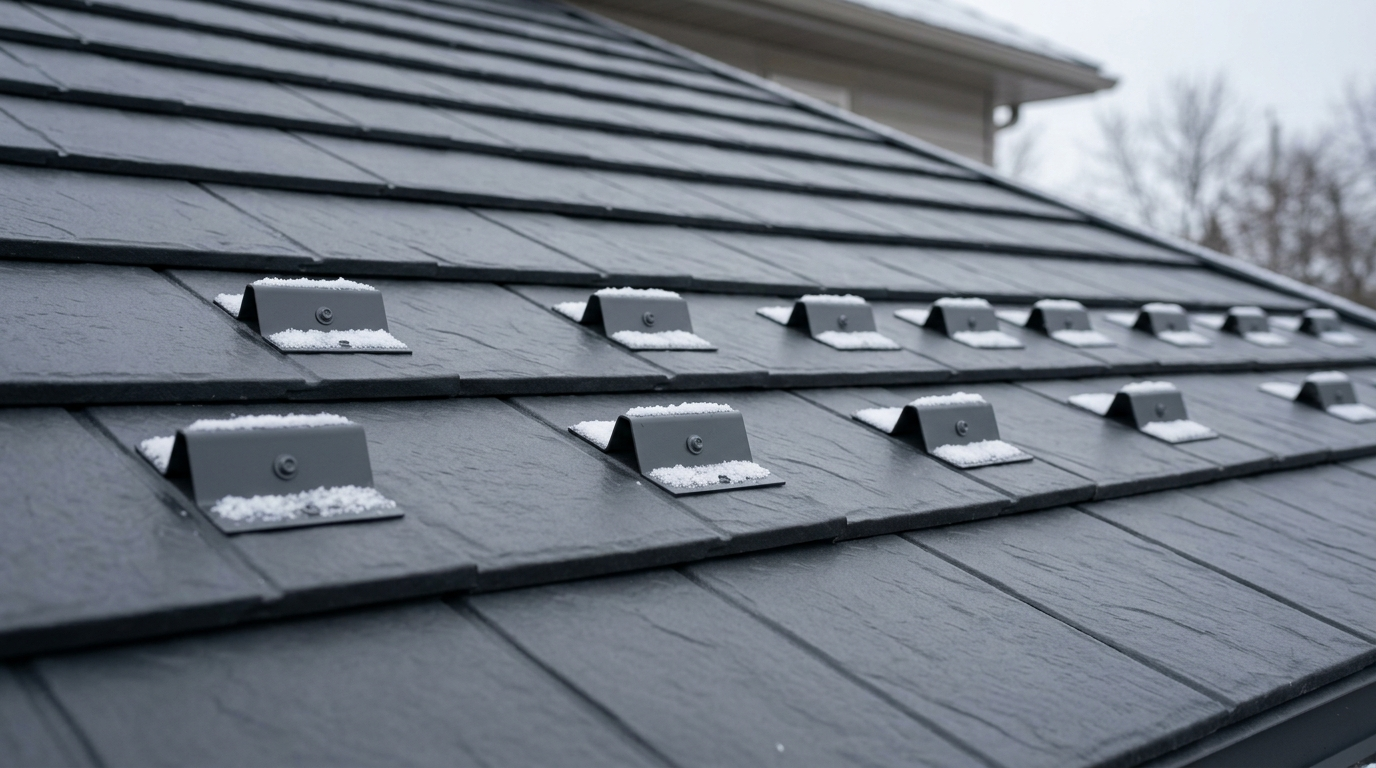
A retrofit also means people walking on the finished roof, and foot traffic is its own risk on interlocking metal. The same EDCO guide warns installers against walking on the four-way interlock where its pieces meet, and it calls for OSHA-approved fall protection whenever anyone works on a roof. That makes adding guards to an existing shingle roof work for a crew that knows that particular product.
What Do Snow Guards Cost When Installed in Asheville?
We've kept this section to national figures, each from the company named in its sentence, and none of them is a price for any particular Asheville roof.
For a continuous rail, S-5!'s ColorGard 2.0 product page listed a cost range of $6.75 to $11.50 per linear foot of assembly as of October 2026, and it says costs vary widely with the size of the purchase and the project. For a lighter system, New Tech Machinery, which makes metal roofing equipment, put S-5!'s single-rod SnoRail at a cost starting around $6.50 per foot installed in a March 2025 review, describing it as a system for areas with light to moderate snow.
Both figures are per foot, so the total turns on how many feet of eave the layout protects and how many rows it calls for. Two quotes built on different layouts aren't comparable, and the layout shows whether a price covers the whole eave line or a patch above the door.
Doing the job yourself means working on the roof yourself, with the fall-protection and foot-traffic cautions from the metal shingle section above. If you're pricing the roof itself rather than the guards, our breakdown of standing seam metal roof costs in Charleston covers that side of the budget.
Do Snow Guard Clamps Damage the Roof Warranty for Asheville Homeowners?
A clamp your panel maker approves, installed to its instructions, stays within what that maker allows. The risk lies with attachments the panel maker hasn't approved, and with fasteners driven through a standing seam panel.
S-5!'s homeowner article on protecting a roof's warranty says many manufacturers specify that the type of attachment can affect a warranty's validity. It also says unnecessary penetration of the panel can void a manufacturer's warranty. Its advice is to check the metal roof panel maker's guidelines for which attachments are approved, and to read the warranty itself.
SnoBlox-Snojax is blunter about standing seam in the guide cited above: it says it never recommends putting mechanical fasteners through a standing seam roof, because of the way those panels float, and that doing so can lead to leaks, panel damage, a guard that loosens and lets go, or loss of the manufacturer's warranty.
Clamps come with a trade-off of their own: the clamp makers disagree about which setscrew tip is gentler on the finish. S-5!'s article says cup-point setscrews can cut through a metal roof's protective coating, while SnoBlox-Snojax, which uses cup-point screws, says round- and bullet-point screws can slip down the rib and mar the panel. A disagreement like that is why the panel maker's guidance carries more weight than either clamp maker's claims.
EDCO's guide points the same way for its own metal shingles: it states that its application instructions must be followed for the roof to qualify for protection under the manufacturer's warranty, and those instructions include its section on snow retention. If your roof is already on, find the panel or shingle maker's warranty and read what it says about attachments before anyone adds guards. If you're still planning the roof, settle the question before the first panel goes down.
The Bottom Line
Snow guards on an Asheville metal roof are a decision about each slope, not a default.
- Asheville averaged 10.2 inches of snow a year over 1991 to 2020, according to the State Climate Office of North Carolina, and the Metal Roofing Alliance warns that even a few inches of ice and snow can cause a heavy, sudden slide, especially on steep pitches.
- Whether a house needs guards depends on what sits below each slope (entries, walkways, decks, parked cars, equipment and lower roofs) and on how high the house sits.
- The Metal Roofing Alliance's general guideline is to protect the entire eave line rather than one isolated area, and it warns that shortcuts such as guards only above a doorway can make snow shedding even more unpredictable.
- On standing seam, SnoBlox-Snojax advises against screws through the panel and S-5! warns that unnecessary penetration of the panel can void a manufacturer's warranty; on metal shingles, start with the guard and instructions the shingle maker specifies.
- The published figures here are national and per foot, so judge any quote by the layout behind it.
- S-5! says many manufacturers specify that the type of attachment can affect a warranty's validity; read what the panel or shingle maker's warranty says about attachments before anyone adds guards.
If a metal roof is part of your plans for an Asheville home, our page on roofing in Asheville is a good place to begin. Every job starts with a free inspection.