How to Tell if Wind Damaged Your Charleston, SC Roof
RoofingBaker Home Exteriors
After a storm, one question about a shingle roof matters more than the rest: did the wind do this, or is the roof just old? The answer shapes what comes next, from a straightforward roof repair to a harder conversation about a roof that has reached the end of its life.
Lowcountry roofs see their share of wind. In its 2019 climatological study, the National Weather Service office in Charleston counted 17 tropical cyclones (the term covers hurricanes, tropical storms and tropical depressions) that made landfall in Charleston County from 1851 through 2018. That is a count of landfalls only, so it leaves out thunderstorms and the storms that stayed offshore.
Wind damage and normal aging can look alike from the driveway, and the difference between them is the same line insurers draw between a storm claim and wear and tear. Below, we walk through the evidence that separates the two on a Charleston, SC roof.
How Can You Tell Wind Damage From Normal Aging on a Charleston Roof?
Look at the pattern, not just the worst shingle. Wind damage is an event: it appears after a specific storm and leaves physical marks such as creases, tears and missing pieces. Aging is a process: it builds over years and shows up as curled or cupped edges, surface cracks and bald patches where the granules have worn away.
| What to compare | Points toward wind | Points toward age |
|---|---|---|
| When it appeared | Right after a specific storm | Gradually, over years |
| Where it sits | Exposed areas such as eaves, hips and ridges, checked against the storm’s wind direction | Builds over years, not in one storm |
| What the shingle shows | A crease, a tear or a missing tab | Cupped or curled edges, surface cracks, bald patches |
| Unsealed tabs | Alongside creases or tears | On their own, or running diagonally up the slope |
| Granules | A thin worn line about 1 to 2 inches below the shingle above | General wear and loss over time |
An older roof can show both at once, which is why the sections below take one clue at a time.
Check what you can from the ground or from inside the house, and stay off the roof and off any ladder at the eave. Owens Corning’s guide to signs of storm damage suggests viewing the roof from a window inside the house or with binoculars from the ground, and contacting a professional roofing contractor if in doubt. Missing shingles and debris can show from there. Creases, unsealed tabs and worn granule lines usually cannot.
For the general warning signs and the first steps after a storm, start with our roof damage action plan, which recommends a prompt inspection after storms with sustained winds above 40 mph.
Why Do Wind-Creased Shingles Look Different From Shingles Curled by Age?
Because different forces make them. A January 2018 article in Interface, the technical journal of the International Institute of Building Enclosure Consultants (IIBEC), describes how wind does it. Once the factory adhesive fails, a rising shingle exposes more of itself to the wind, which tends to flip it and crease or tear it, and the failure typically sits at the top of the exposed part of the shingle, just below the edge of the shingle above. What is left is a fold line across the shingle. The article adds that on the new, pliable shingles in the wind-simulator test it describes, a crease took very close inspection to see.
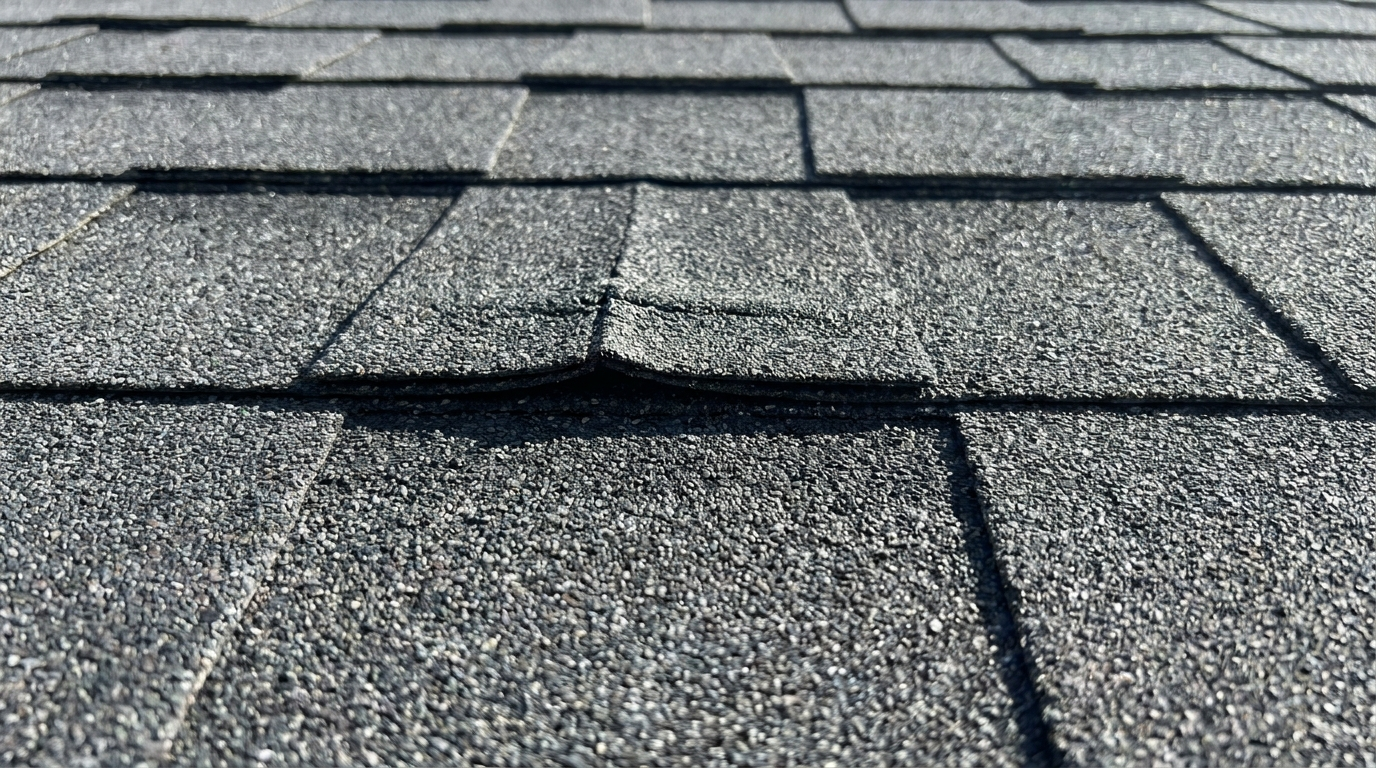
Age curling builds over years instead. Owens Corning’s guide to when to replace your roof lists cupped shingles with concave centers, wavy surfaces, and ragged or curled edges among the signs that a roof is past its prime, and says UV exposure over the years may cause shingles to dry out and crack on the surface.
Put simply, a crease is a line across a shingle that may have settled back flat. Curling is a shape.
Which Roof Slope Takes Wind Damage First on Charleston Homes?
On a Charleston home, the parts of the roof most exposed to the wind are where the evidence starts, and which slope took the damage is read against the direction the storm’s wind came from. The IIBEC article says that when the wind force is strong enough to break tabs or shingle sections off, this is particularly the case in areas of the roof exposed to higher wind forces, for example eaves, hips and ridges.
Direction is part of the evidence too. The article’s authors write that a proper wind damage assessment should consider where the damaged shingles are, any pattern of unsealed shingles across a slope and across the entire roof, which way the slopes with unsealed shingles face, and the prevailing direction of the wind during the storm in question.
That is why the storm’s date matters: it ties what is on the roof to the wind of that storm, not to every storm since the roof went on.
Can Unsealed Shingle Strips Prove Wind Damage in Charleston?
Not on their own, though a broken seal does matter. IBHS, the Insurance Institute for Business & Home Safety, says its wind testing has shown that the strength of the seal between shingles is the most important factor in how self-sealing asphalt shingles perform in high winds. That seal is a temperature-activated adhesive strip, applied at the factory, that bonds the lower edge of each exposed shingle to the shingle below.
But a seal can let go without a storm. The IIBEC article lists manufacturing inconsistencies, improper installation, aging and deterioration, installation during cold weather, contamination of the adhesive, and repeated heating and cooling (thermal expansion and contraction) as factors that weaken shingle adhesion. Its authors write that, in their field observations and laboratory testing, a sealed-down shingle affected by wind leaves lasting evidence, and that a shingle that is simply not adhered, with no crease, fold, tear or missing piece, is not evidence of wind-caused damage. The article itself calls wind-lifted shingles a controversial subject in the roofing industry, but the practical point for a Charleston homeowner is plain: unsealed strips alone make a weak case.
Unsealed tabs carry more weight when they come with other evidence:
- They are also creased, folded or torn.
- They sit in areas exposed to higher wind forces, such as eaves, hips and ridges.
- Their pattern follows that exposure. The same article notes that repeated heating and cooling leaves unsealed overlaps running diagonally up the slope, following the pattern in which the shingles were installed, and that this pattern does not vary where wind uplift would be greater or less.
What Debris and Granule Clues Point to Recent Storm Damage for Charleston Homeowners?
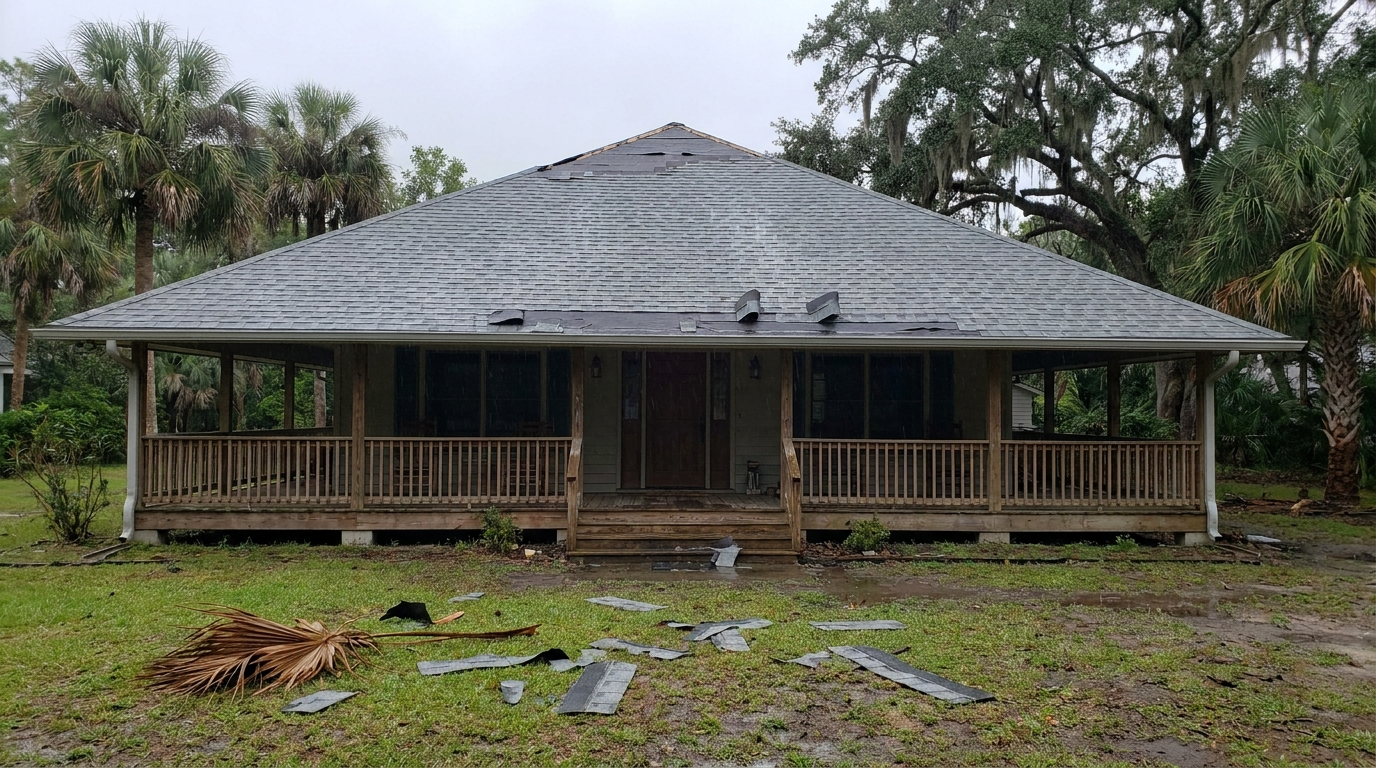
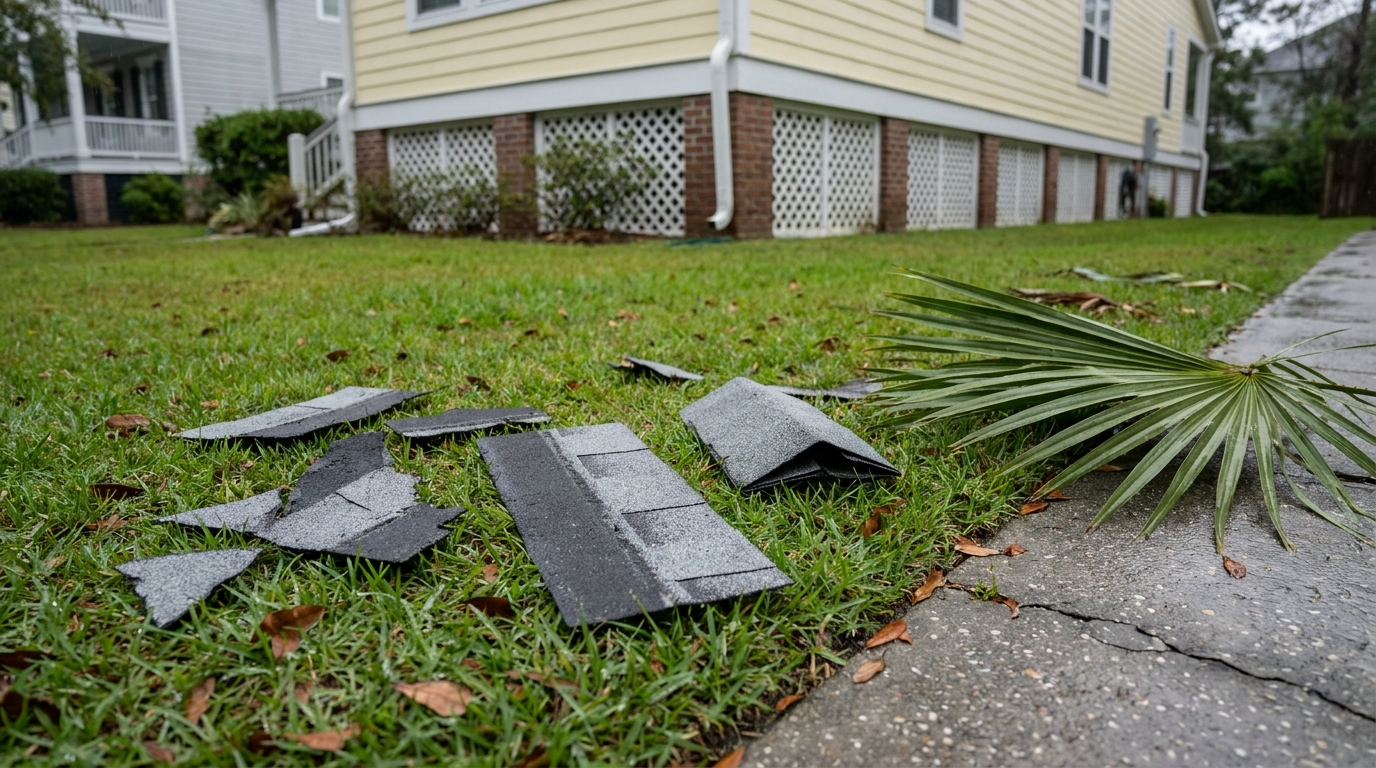
Debris is one of the clearest signs of recent storm damage a homeowner can see from the ground. The IIBEC article notes that when the wind force is strong enough, tabs or sections of shingle break off and are carried downwind, so shingle pieces, whole tabs or ridge cap in the yard or on the driveway the morning after a storm tie the damage to that storm. Branches or palm fronds on the roof after the storm are worth noting too.
Granules on their own are a weak clue. Our roof damage action plan treats granule loss as normal aging, low in urgency: monitor it and plan for future replacement. Granules in the gutters can come from an aging roof or from a storm, so by themselves they do not date the damage. Bruises and divots where granules were knocked off point to hail, which our guide to how to tell if your roof has hail damage covers.
The granule clue that points to wind sits up on the roof. Owens Corning’s storm-damage guide describes thin horizontal lines where granules have been worn off about 1 to 2 inches beneath the shingle above, and says this could indicate that the seal was broken and the shingle was flapping in the wind, rubbing against the shingle above it.
Why Do Insurers Call Some Charleston Wind Claims Wear and Tear?
Because a homeowners policy typically pays for damage from sudden events like wind, not for a roof wearing out, and on an older roof the two can look alike. Our guide to whether homeowners insurance covers roof damage explains the basics, and only your policy and your insurer can say what yours covers.
Older roofs also tend to take more damage from the same wind. A 2026 study of asphalt shingle roofs after Hurricane Laura in 2020, published in the Journal of Building Engineering and listed by the National Institute of Standards and Technology, found roof age to be a clear factor in the level of roof cover damage in areas with similar peak wind speeds, while calling for more work to separate age from factors such as construction quality and maintenance history. So on an older roof, the same damage can be read as the storm’s work or as the roof’s age.
A wear-and-tear reading rests on the aging signs covered above — curled or cupped edges, surface cracks and bald patches — and on unsealed tabs with no crease, fold, tear or missing piece.
If your insurer denies all or part of a claim, the South Carolina Department of Insurance’s Post-Disaster Claims Guide says to ask for the denial in writing and keep all paperwork. If you don’t believe an offer is fair, it says to call the insurance company and be prepared to explain why, and if you are not satisfied with the response, you may file a complaint with the department. For a claim you think the insurer should have paid, it also describes arbitration or a lawsuit, and says you may want to file a complaint with the department before either.
What Should a Roofer Photograph to Document Wind Damage in Charleston?
Enough to show the pattern, not just the worst shingle. The question turns on where the damage sits and how it is spread, so a useful wind damage file covers the whole roof. This is the roofer’s job on the roof; a homeowner’s part stays on the ground. The photos should show:
- Every slope in a wide shot, with the direction it faces noted. The IIBEC authors list where the damaged shingles are and which way the slopes with unsealed shingles face among what an assessment should consider.
- Exposed areas such as the eaves, hips and ridges, up close.
- Each crease, tear and missing tab, close enough to show the fold or the torn edge, plus a wider shot of where it sits on the slope.
- Unsealed tabs, whether they are creased or torn, and whether their pattern follows the wind exposure or runs diagonally up the slope.
- Any thin line of worn granules about 1 to 2 inches beneath the shingle above, the wind clue described in the previous section.
- The rest of the roof, whether it shows curling, cupping, cracks and bald patches or is in sound shape, so the age question is answered in the same file.
- The date of the storm, so the photos can be read against that day’s wind.
Your own photos from the ground still count, and our Charleston storm repair guide covers which storm damage to document before paying for repairs.
During our free on-site inspection in Charleston, the project manager photographs what the inspection uncovers, and you get a written quote with options.
Key Takeaways
- Wind damage is an event and aging is a process. Creases, tears and missing tabs that appear after a storm point to wind, and the parts of the roof most exposed to the wind, such as eaves, hips and ridges, are the place to start; cupped or curled edges, surface cracks and bald patches point to age. An older roof can show both.
- Unsealed strips matter, but on their own they do not prove wind damage, since seals can also let go from causes such as aging, improper installation and repeated heating and cooling.
- Fresh debris after a storm ties the damage to that storm. Granules on their own are a weak clue.
- On an older roof, the same damage can be read as the storm’s work or as the roof’s age, which is why the evidence matters.
- Check what you can from the ground or from inside the house, with binoculars or from a window; stay off the roof and off any ladder at the eave; and contact a professional roofing contractor if in doubt. Our roof damage action plan recommends a prompt inspection after storms with sustained winds above 40 mph.
If a storm has passed over your roof and you cannot tell what you are looking at, our Charleston roofing team can take a closer look. Every job starts with a free on-site inspection, and the project manager photographs what the inspection finds.