What to Do When a Tree Falls on Your Greensboro Home
RoofingBaker Home Exteriors
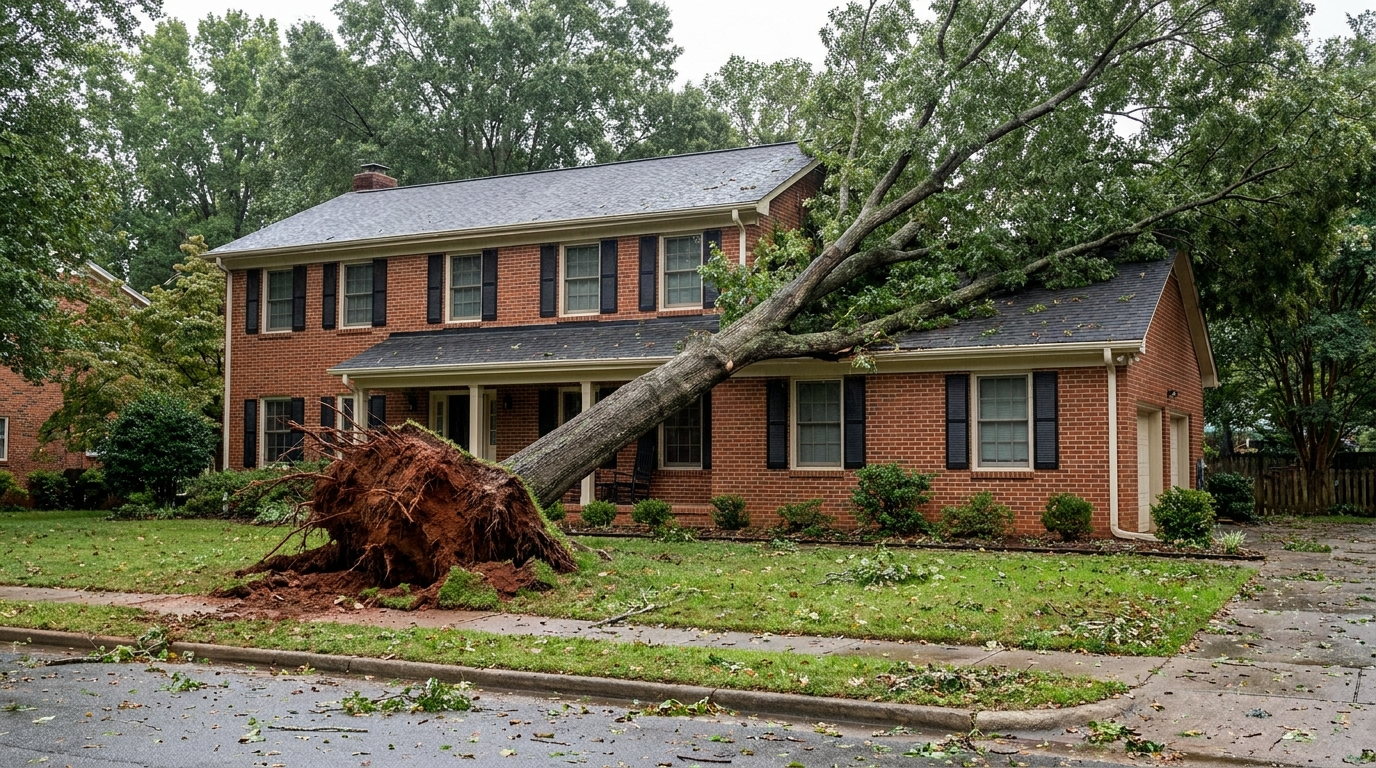
When a tree comes down on your house, the order of the next few calls matters as much as their speed. People and power lines come first. A tree service comes second, because the tree has to come off before anyone can safely inspect or cover the roof. A roofer comes third, to check the framing, get a tarp over the opening and plan the roof repair. Calling in that order keeps everyone out from under a load nobody has assessed yet.
A single evening of storms can bring trees down across Greensboro. In its September 5, 2026 storm update, the City of Greensboro said Friday evening’s storms had resulted in approximately 77 reported fallen trees. Below, we walk through each step for homes in Greensboro and across the Triad, including who pays when the tree was your neighbor’s, what homeowners insurance pays to remove it, and what the City will and won’t pick up at the curb.
What Should You Do First When a Tree Falls on a Greensboro House?
Get everyone away from the damage, keep clear of the tree and any utility lines, and make the emergency calls before anything else. This is the order we recommend, built on the City of Greensboro’s storm guidance and the gas-leak steps published on Ready.gov, the federal government’s emergency-preparedness site:
- Move everyone, pets included, away from the damaged part of the house. Keep people out of any room, hallway or attic space the tree has broken into or is resting over. If a ceiling is sagging or you smell gas, get everyone out of the house.
- Call 911 if there is an immediate threat to life or safety. That is the threshold the City of Greensboro gave residents in its September 5, 2026 storm update, which pointed non-emergency storm concerns to the City’s contact center or the police non-emergency line instead. Someone who is hurt or trapped, or any sign of fire, meets the 911 threshold.
- Stay away from the tree and from every line near it. The same City update told residents to stay away from fallen trees and downed power lines. Give a line tangled in the branches the same distance you would give one lying in the yard, and keep children and pets back from both.
- Report downed lines and outages to Duke Energy. The City’s update asked residents to report power outages and downed utility lines directly to Duke Energy.
- If you smell gas or hear a blowing or hissing noise, follow the gas steps. Ready.gov’s Safety Skills page says to open a window, get everyone out quickly, turn off the gas at the outside main valve if you can, and call the gas company from a neighbor’s home. Shut-off procedures differ from one gas meter to another, which is why the same page tells households to learn theirs from the gas company ahead of time. Once the gas has been turned off for any reason, only a qualified professional should turn it back on.
- Leave the tree where it lies. Don’t start cutting it or try to pull it free. Removing it is a job for a tree service, for the reasons in the next section.
Once everyone is safe, the rest of the first day (photos of the damage, the call to your insurer, and why no one should climb onto the roof or tarp it themselves) is covered step by step in our roof damage action plan.
Why Should the Tree Come Off Before a Roofer Repairs the Damage?
Because a roof cannot be properly inspected, covered or repaired while a tree is still lying on it, and because the tree may be holding part of the house together. A trunk resting in a roof can be pinning broken rafters in place, holding torn decking closed, or keeping its weight on framing that is already cracked. Lift it the wrong way and that load can shift suddenly, onto the house or onto whoever is underneath. Getting it off is rigging work, sometimes with a crane, and it has to happen before a roofer can see what is left.
That makes it work for tree professionals. NC State Extension’s guide to storm-damaged trees lists reasons to hire a certified arborist, among them when pruning will require a ladder or chainsaw, when a crane or other large equipment will be needed, when there are power lines in the area, when there is potential for property damage, and when bent or twisted branches are under pressure and may cause kickback. A tree on a house can meet several of those conditions at once. The International Society of Arboriculture keeps a directory for finding and verifying ISA-credentialed arborists, and it is reasonable to ask any tree service for proof of liability insurance before its crew starts.
Tree removal belongs to a tree service, so once the emergency calls are made, the tree service is the first contractor to call and we come right after it. A tarp has to seal against the roof around the opening, which it cannot do with a trunk or limbs still in the way. Once the tree is off, we usually schedule a free inspection within 24 to 48 hours, and if it is active storm damage we can often get a tarp on the same day to stop the water while we plan the fix. If the tree service gives you a time when the roof will be clear, tell us when you call.
How Do Roofers Check Rafters and Framing After a Tree Hits a Home in Greensboro?
From both sides of the roof deck, and well past the hole you can see from the yard. The hole only marks where the tree broke through. The force of the strike spreads into the rafters or trusses around it, so a careful framing check covers the whole impact zone and the rooms below it, not just the opening.
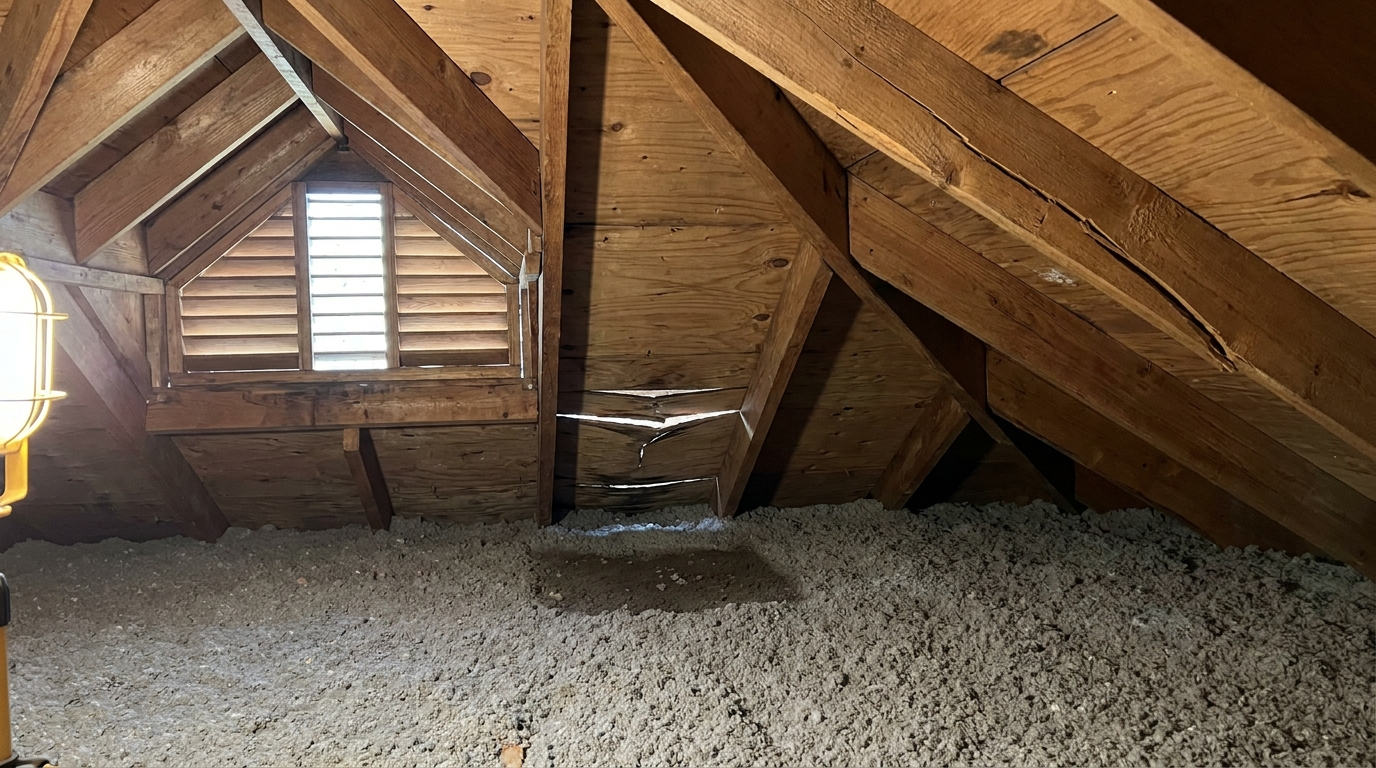
Inside the Attic
- Rafters or truss members that are cracked, split, broken or bowed
- Joints that have pulled apart, and nails backed partly out of the wood
- Decking that is cracked, punched through or pushed down between the framing
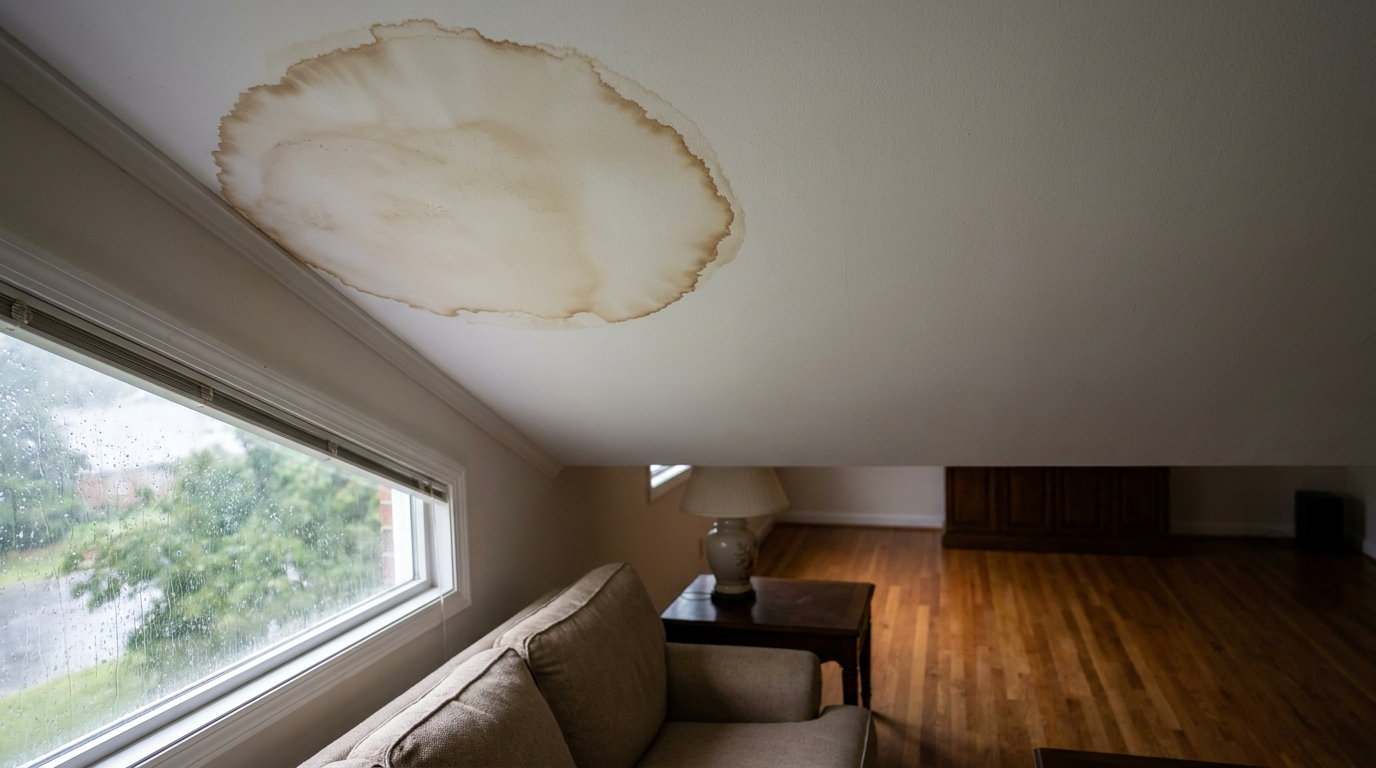
- Daylight where there should be none, and wet insulation or fresh stains where rain got in
Outside and Below the Impact
- A ridge line or roof plane that dips where it used to run straight
- Rafter ends along the eave that cracked where a trunk came down across the edge
- New cracks or a sag in the ceilings of the rooms under the impact
Every job starts with a free on-site inspection. Our project manager photographs what they find, and the quote comes back written, with options. Where the decking is cracked or punched through, we replace it. Where a rafter or truss is broken, the framing has to be made sound before new decking and shingles go on.
Who Pays When a Neighbor’s Tree Falls on Your Greensboro Roof?
In most cases, your own homeowners insurance. The NC Department of Insurance answers this directly in its homeowners insurance FAQ: generally, if a tree falls on your home or other structure, your own homeowners policy would cover the damage. So even when the tree grew next door, the claim normally starts with your insurer, not your neighbor’s.
That does not settle every question of fault. Consumer Reports’ explainer on fallen-tree claims notes that your insurer might try to get reimbursed by the neighbor’s homeowners policy, a process called subrogation. Subrogation is your insurer’s process to pursue, so it is not something you have to negotiate with your neighbor yourself. If you believe the tree was dead or visibly failing before the storm, tell your insurer when you report the claim. For the broader picture of how homeowners coverage treats roof damage, our guide to whether home insurance covers roof damage walks through it.
Does Homeowners Insurance Cover Tree Removal for Greensboro Homeowners?
Up to a limit, and generally only when the tree damaged a structure or blocked the driveway. The NC Department of Insurance’s homeowners FAQ says the homeowners policy will pay reasonable expense, up to $500 for any one loss, to remove trees from your premises, provided the tree has damaged a structure or blocked the driveway. The Department’s claims and adjuster guidance adds that most companies will pay, up to a limit, to remove a tree from a damaged structure such as a home, garage or fence, but will not pay to remove a tree from your yard.
Three points follow from that. The $500 in the FAQ is for removing the tree, not for repairing the house. The amount your own company pays is the one that counts, which is why the Department tells homeowners to check with their agent or company to find out what theirs will pay. And a tree that came down in the yard without damaging a structure or blocking the driveway is generally yours to clear. Ask your agent about the removal limit as early as you can, and keep the tree service’s itemized invoice with your claim paperwork.
Who Hauls Away a Fallen Tree in Greensboro, and What Goes to the Curb?
You do, through the tree service you hire. In its September 6, 2026 storm debris update, the City of Greensboro said City crews cannot enter private property to cut or remove trees or debris, and that debris must be moved to the curb for collection. A tree lying on your house is on private property, so cutting it up and clearing it from the lot falls to the tree service. When you compare quotes, ask whether the price includes hauling the wood away or only cutting it into sections.
For homes on City of Greensboro yard waste collection, what you set out at the curb follows the City’s standing yard waste rules:
- Fill your gray yard waste cart first and close the lid. Long branches sticking out of the cart, or an open lid, can mean it is not collected, and no more than two City carts go to the curb.
- Tie extra branches and brush in bundles no more than five feet long and no heavier than 50 pounds, using twine or string.
- Use only biodegradable paper bags for loose material, and keep each filled bag under 50 pounds.
- Set out no more than 10 bags and bundles a week beyond the cart, or 15 from November through February.
- Have everything at the curb by 7 a.m. on your regular collection day.
- Keep loose leaves and other yard material out of the street and the right-of-way.
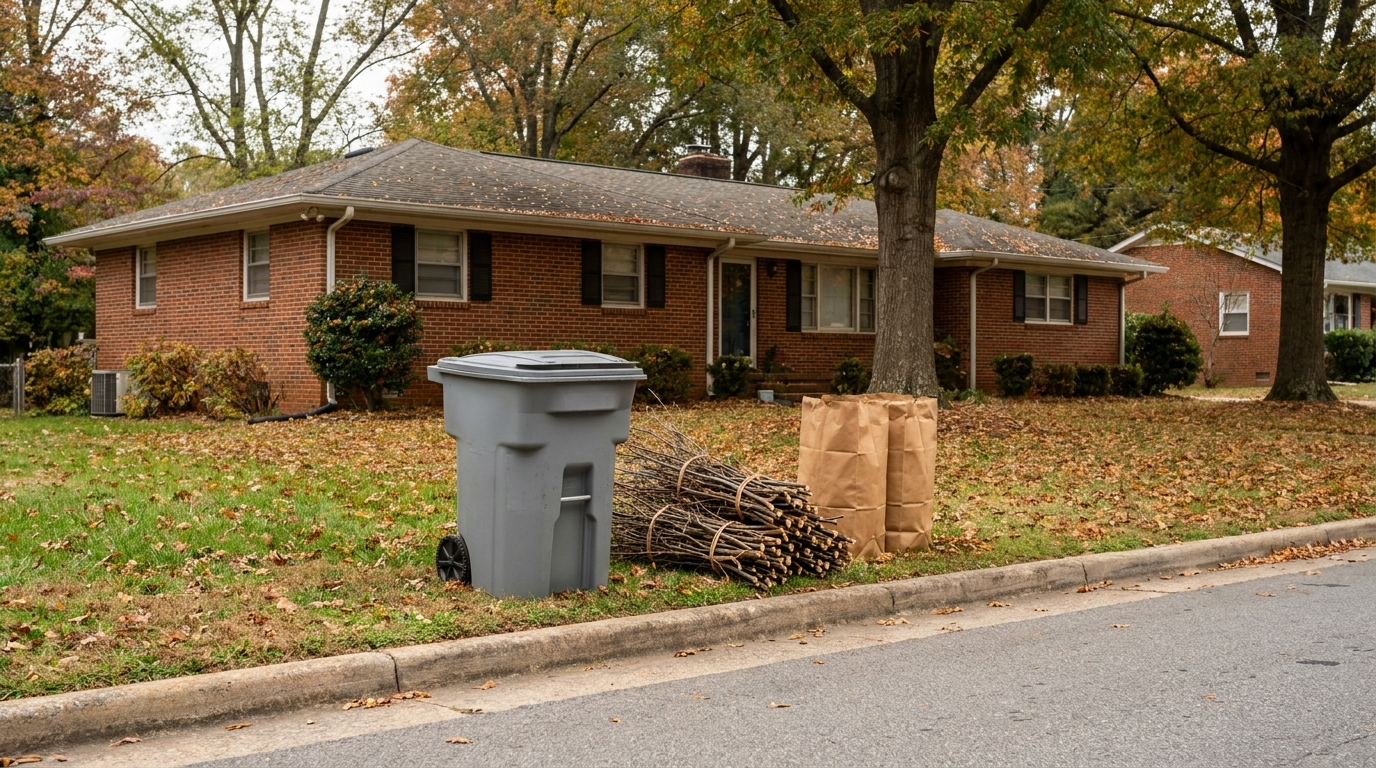
Trunk sections and limbs too big for those limits fall outside the standing curbside rules, so plan on the tree service hauling them. Roofing debris is a separate stream again: shingles, nails and broken decking are not yard waste, and the City’s yard waste cart accepts yard material only. When our repair is finished, we run a magnetic nail sweep before we leave.
How Can Greensboro Homeowners Spot a Tree Likely to Fall Before the Next Storm?
Start with the trees tall enough and close enough to reach your roof, and check them against the warning signs in the same NC State Extension guide. The Extension lists trees with co-dominant leaders (two or more main trunks of similar size), bark pinched into the crotch between them, and cavities or hollow areas as more likely to be damaged in storms, and it says leaning trees should be evaluated. Girdling roots, which circle the base of the trunk, can create a weak spot that is often the point of failure in a storm, and damage from insects or disease can weaken the wood. It also lists old injuries, such as topping, flush pruning cuts, mower and trimmer wounds or roots cut by trenching, and poor sites, where roots are confined, the soil is shallow, compacted or waterlogged, or the tree is the wrong plant for the space. If a tree within reach of your house shows any of these signs, the Extension’s advice is to consider hiring a certified arborist for preventive pruning or removal. That call is better made before the next storm than after it.
What to Do Next
When a tree comes down on your Greensboro home, take it in order. Get everyone, pets included, away from the damage, the tree and any lines, and out of the house if a ceiling is sagging. Call 911 for an immediate threat to life or safety, report downed lines and outages to Duke Energy as the City asks, and follow the gas steps if you smell gas or hear a blowing or hissing noise. Then call a tree service to get the tree off the house, and call us once it is clear so we can check the framing, get a tarp on the opening and plan the permanent repair. On the insurance side, your own policy is generally the one that responds, even when the tree was your neighbor’s, and your agent can tell you what your policy pays for tree removal.
If a tree has come down on your roof, our Greensboro roofing team is the call to make once the tree is off. Every job starts with a free on-site inspection, and the quote comes back written, with options.