How to Remove Roof Moss Safely in Asheville, NC
RoofingBaker Home Exteriors
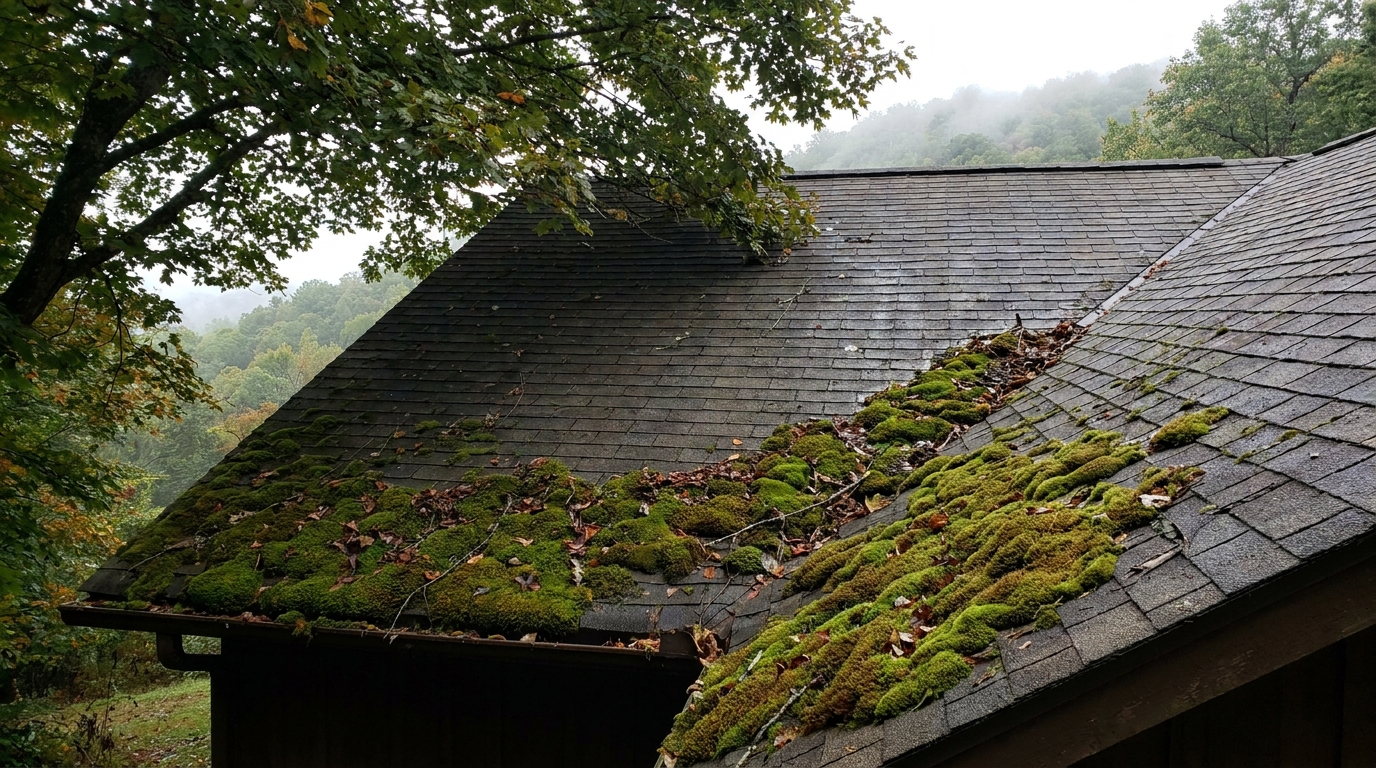
A homeowner shopping for roof cleaning recently got two quotes on the same mossy roof. One company said it could pressure wash the whole thing clean that afternoon. The other refused to touch it with pressure, proposed a low-pressure chemical treatment instead, and warned that the moss would take three to six months to fully clear on its own.
Both were confident. Only one was going to leave the roof intact.
That gap is the entire problem with roof moss. The fastest-looking method is the one that does the damage, and the damage does not announce itself for a year or two. If the moss on your roof has already gotten past the point where a broom will fix it, our Asheville roof repair crew would rather look at it before someone blasts it.
This guide is about method — what works, what quietly wrecks a roof, and where the line sits between a Saturday job and a call. Gutters are their own maintenance item, covered in our walkthrough on clearing gutters.
How Do You Remove Roof Moss Safely on an Asheville Home?
Safe moss removal is slow, gentle, and done in a specific order. Nothing about it is dramatic.
Two credible sources sequence it differently. Oregon State University’s Extension Service starts with physical removal: “Getting rid of moss doesn’t rely on chemicals, alone. Instead, it begins with physical activity to remove it with a brush or broom” — a bristle scrub brush or stiff broom, then a protective product to slow regrowth. The Asphalt Roofing Manufacturers Association starts with the chemistry: a 50:50 mix of laundry-strength chlorine bleach and water, left to dwell 15 to 20 minutes, then rinsed with low-pressure water, with the loosened moss cleared later by leaf blower.
Both are defensible, and on the roofs we see the two blend. What matters more than the order is the technique underneath it.
- Work downward, never upward. Brushing or blowing up the slope drives debris and water underneath the shingle edges, which is the opposite of what a roof is built to do.
- Be gentle enough to feel silly. You are trying to dislodge the moss, not scour the shingle.
- Protect what is below first. Bleach solution runs off exactly where your landscaping is, and the manufacturers’ guidance is explicit about taking precautions for surrounding areas.
- Accept that it takes weeks. Dead moss releases slowly, with weather. A roof that looks perfect the same afternoon was almost certainly cleaned the wrong way.
Why Do Shaded Asheville Roofs Grow Moss Faster Than You Can Remove It?
Because in the coves around Asheville, the conditions that grow moss never really switch off.
Moss is a non-vascular plant, which means it takes up water through its leaves rather than through roots. It needs a persistently moist surface to live on. That is why, as ARMA notes, moss in North America tends to colonize north-facing roof planes — the ones that get less direct sun and stay damp longer than the south-facing side of the same house.
Add mature hardwood cover and it compounds. Overhanging branches do two things at once: they hold shade over the roof, and they drop debris that traps moisture and then feeds the moss as it breaks down. A great many Western North Carolina homes sit in exactly that situation — on a shaded slope, under old trees, in a climate with reliable summer humidity and a wet winter.
This is why homeowners here often feel like they are losing ground: they remove the moss without changing anything about why it grew. Cleaning is the treatment; sunlight is the cure. Trimming branches back to get light onto the roof plane does more long-term good than any product on the shelf, and it appears in essentially every credible source on the subject.
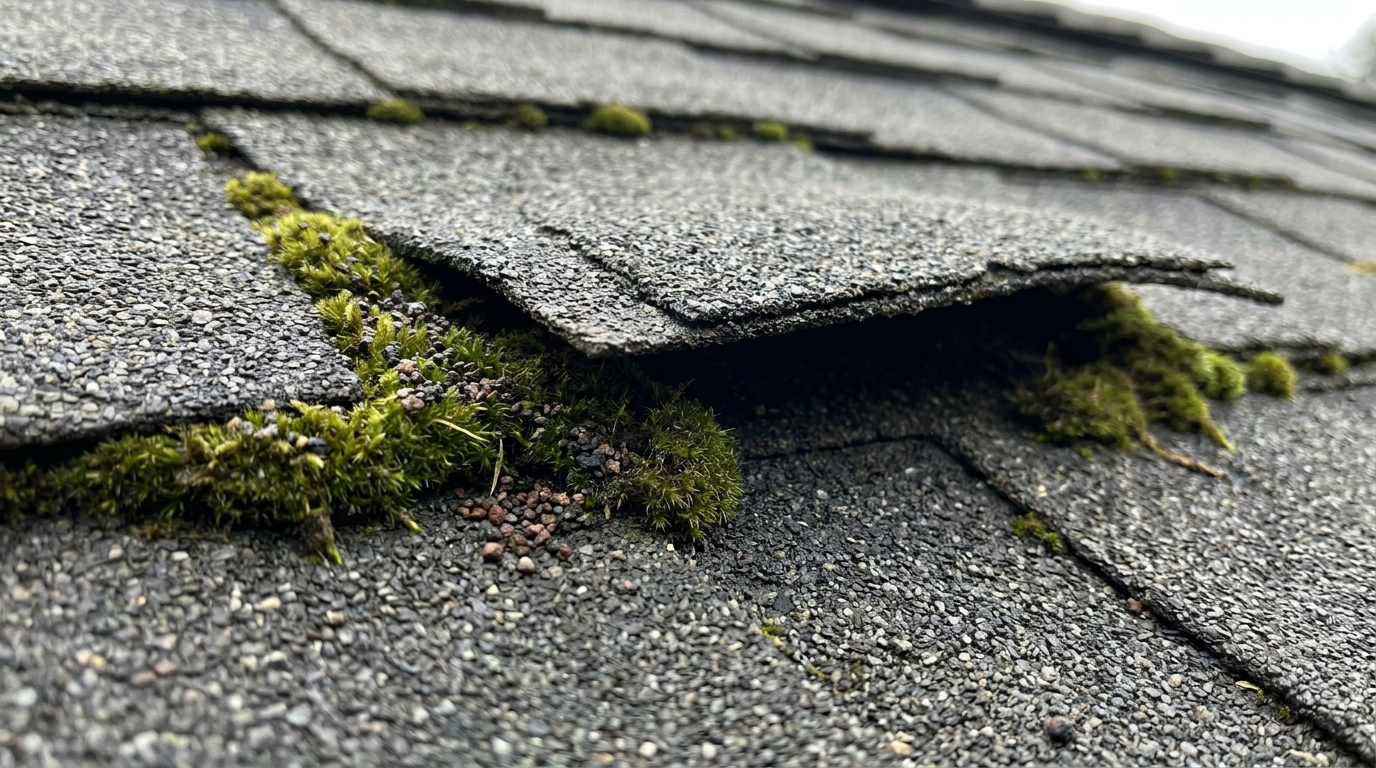
Moss also does not stay cosmetic. ARMA is direct that moss can be detrimental to asphalt shingle performance: it can lift or curl the leading edges of shingles, raising the risk of blow-off in wind, and heavy build-up can push water sideways under the courses, into the deck. That is the point where a maintenance chore becomes a repair. If you are weighing how much service life is actually at stake, how long a shingle roof should last puts the timeline in context.
What Should Asheville Homeowners Never Use to Clean Roof Moss?
Anything that removes moss faster than the moss wants to come off.
A pressure washer. This is the big one, and it has its own section below.
Metal scrapers and wire brushes. A putty knife or wire brush will take moss off an asphalt shingle, and the granule surface with it. Those granules are the shingle’s weather layer, not decoration.
Anything applied without checking where it drains. Homeowners learned this the practical way — one warned others to “be mindful where it drains to afterwards. Don’t want to kill off your flowerbeds in the process.” That squares with the manufacturers’ own instruction to protect landscaping from the bleach solution and to wear proper protective equipment.
One more, in the interest of honesty: powdered laundry detergent sprinkled on the roof comes up in homeowner threads, and two of the homeowners we read reported it worked. We will not recommend it. No manufacturer or extension service backs it, and one of the two flagged groundwater himself. “It worked on my roof” is not the same as “it is safe for your roof.”
Does Pressure Washing Remove Moss or Ruin an Asheville Roof?
On an asphalt shingle roof, it does both — and that is exactly why it keeps getting sold.
Pressure genuinely does clear moss, immediately and visibly, which is what makes the same-day quote so persuasive. The cost is invisible on the day. ARMA’s guidance is unusually blunt for an industry body: never use a pressure washer on an asphalt shingle roof, because it “will cause granule loss and very likely premature failure of the roof system.” OSU Extension arrives at the same place from a different direction, warning against any high-pressure device because they “degrade roof quality and longevity by removing some of the gravel layer added to the roofing during the manufacturing process.”
The trade discussion runs the same way. In the thread we opened with, four commenters told the homeowner never to put pressure on a shingle roof — one identifying as a full-time roofer and part-time pressure washer, who put it plainly: “You will lose granules and void the warranty if you’re ever to get storm damage.” One dissented, arguing low enough pressure is fine. The homeowner went with the soft-wash company.
We would too, and not out of caution for its own sake. Granule loss is not reversible. Once the surface is stripped, the asphalt underneath takes UV directly and the roof ages on a faster clock from that day on. You do not get a warning. You get a shorter roof.
Which Moss Treatments Work on Asheville Roof Shingles?
The treatments with real backing are less exciting than the products marketed at this problem.
The bleach-and-water solution. ARMA calls a 50:50 mix of laundry-strength chlorine bleach and water the most effective method for both algae and moss. Spray, dwell 15 to 20 minutes, rinse thoroughly with low-pressure water. Longer dwell times are sometimes needed, but never let it dry completely on the roof — that interferes with rinsing it off. Severe growth can take more than one treatment.
Commercial moss products. These work, with a caveat. OSU Extension’s assessment is that they “can slow moss development, but they may only be effective for short periods of time and need reapplication,” and that liquids apply more evenly than powders. Treat them as maintenance, not a cure.
Timing matters more here than most places. Treatment needs a dry stretch, and mountain shoulder seasons do not always cooperate — a homeowner in one thread talked himself out of a late-autumn attempt because the cold and the rain-and-snow mix meant no cleaner would sit on the roof long enough to work. Late spring through early autumn is the window, which lines up with our fall home maintenance checklist.
A note on scope: this is asphalt-shingle guidance, which is what most Asheville homes wear. Cedar has different rules, covered in our guide to cedar shakes and shingles.
How Do Zinc and Copper Strips Prevent Moss on Asheville Roofs?
The mechanism is real and simple. A strip of zinc or copper near the ridge sheds a small quantity of metal ions every time it rains, the runoff carries them down the slope, and moss struggles to establish in that water.
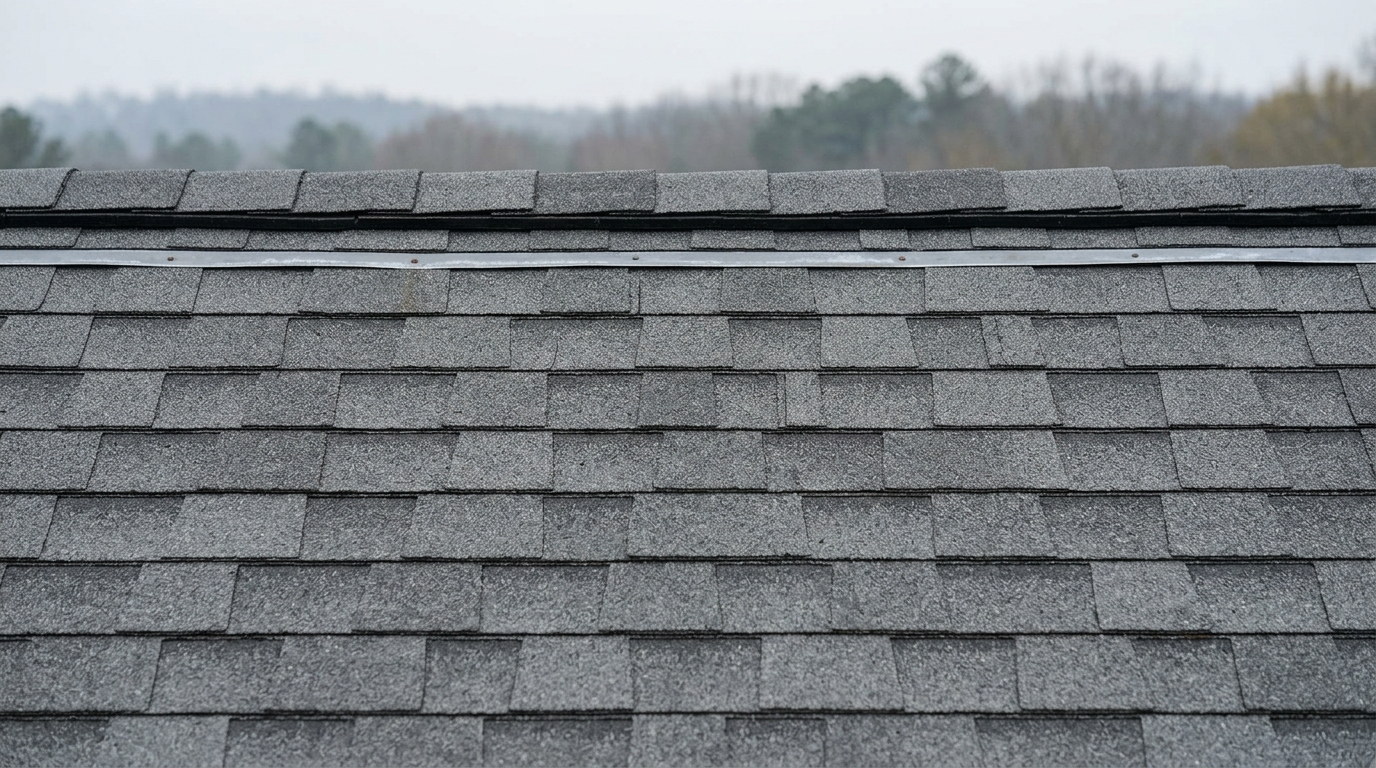
It is also the most confidently repeated advice on the internet about roof moss — and the version most people repeat is the one shingle manufacturers specifically warn against. In the homeowner thread we reviewed, the top-voted answer by a wide margin, 32 upvotes, was to nail a zinc strip along the ridge and let the rain do the rest, with a follow-up explaining how: nail it down, tuck part of the strip under the top course of shingles.
Now the manufacturers’ position. ARMA states that adding zinc or copper strips to an existing roof is not recommended, for a specific and mechanical reason: doing it requires either fastening the strips with exposed nails, which can cause leaks over time, or breaking the sealant bond between shingles to slide the strip underneath, which can eventually show up as wind damage. Either way, you are trading a moss problem for a fastener problem.
Homeowners in those same threads got there on their own. One asked whether the nail holes would need sealing. Another had already tried it and concluded it was “not really worth the extra effort and holes in the roof.”
So the honest answer is about timing, not rejection. Strips work — install them when the roof is open. ARMA frames them as a measure for when it is time to replace a roof, alongside shingles manufactured with algae-resistant copper granules, which need no penetrations at all. If a roof replacement is on your horizon anyway, that is the moment to solve moss permanently for almost nothing extra.
When Should Asheville Homeowners Call a Pro to Remove Roof Moss?
Earlier than most people do, for two separate reasons.
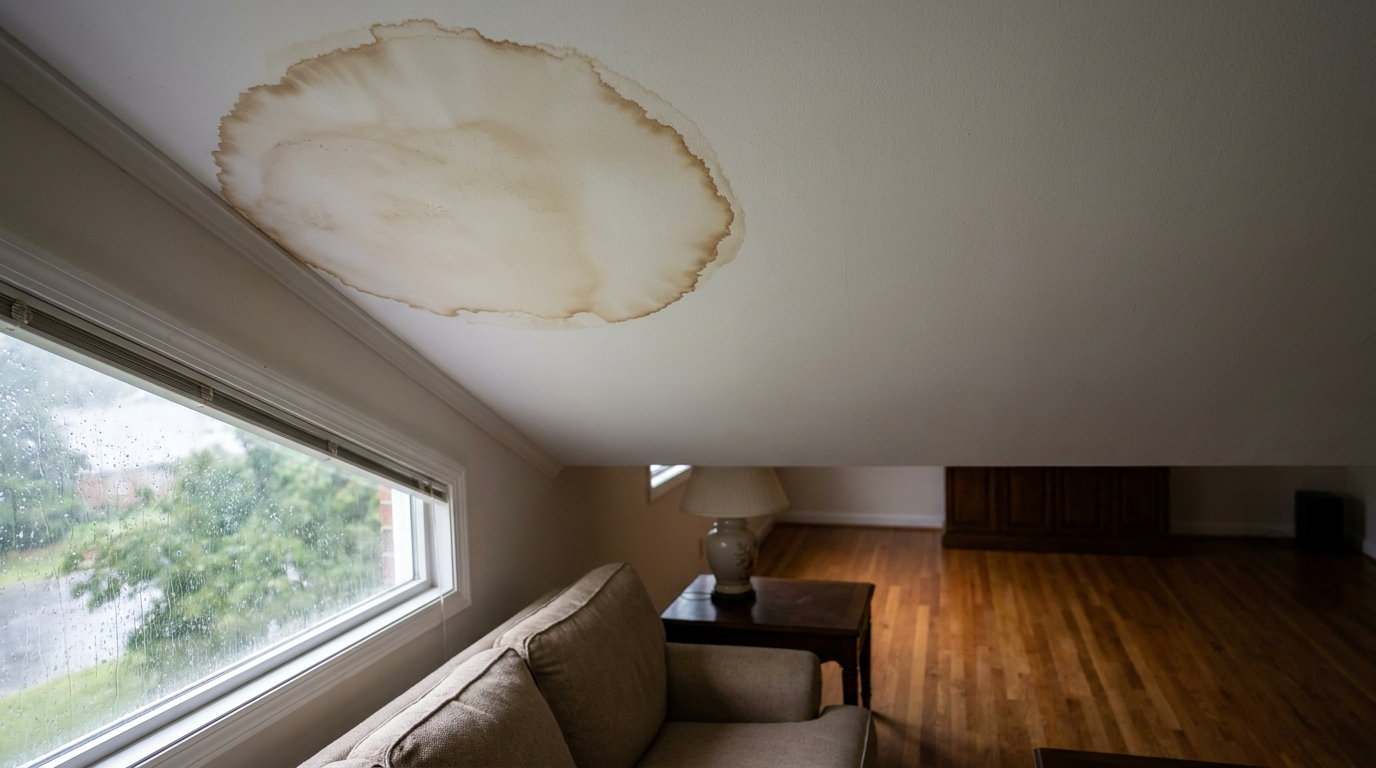
The first is the roof. Some signs mean the moss has stopped being a surface problem: shingle edges visibly lifted or curling, moss thick at the leading edge of the courses rather than just in the valleys, granules collecting in the gutters, or staining on the ceiling below. At that point cleaning is not the job — assessing what the moss has already done underneath is, and a roof inspection will tell you whether this is maintenance or repair.
The second is simpler and more serious. OSU Extension puts it about as plainly as an extension service will: these measures “can be dangerous, due to the slippery surface of the roof where there is moss or algae,” and homeowners should weigh the hazards and seek professional help when needed. A mossy roof is a wet roof with a living, slick layer on it — genuinely treacherous footing, and it does not get less treacherous because you are being careful.
Asheville sharpens both problems. Homes here are frequently tall, steeply pitched and set on slopes, so the ground you would land on is often further down on one side than the other. And the homes that grow the most moss — deep shade, heavy tree cover — tend to be the same ones that are hardest to move around on safely.
If you are unsure which side of that line you are on, we will come look and tell you. A free inspection settles it before anyone climbs anything, and homeowners planning broader work often bundle it with other exterior items — see our notes on Asheville roof and gutter upgrades.
Can Improper Moss Cleaning Void a Roof Warranty on an Asheville Home?
It can — and this is the part that almost never comes up until it matters.
Be clear on who decides. We do not, and neither does a cleaning contractor — the shingle manufacturer’s warranty document does, and coverage varies by manufacturer and product line. What we can tell you is what manufacturers collectively publish about method. Their own association says never to put a pressure washer on an asphalt shingle roof, and names granule loss and premature system failure as the results. A method the manufacturer explicitly warned against, producing damage it explicitly described, is not a strong position to file a claim from.
In the discussion we cited earlier, one commenter noted that where there is evidence a roof was hit with high pressure, the coverage is gone. The full-time roofer in that thread tied it specifically to storm claims — the scenario where you find out years later, at the worst possible moment.
Three things worth doing, none of which cost anything:
- Read the warranty before you clean, not after — look for maintenance and cleaning language, and exclusions covering improper care.
- Keep a record of the method used. If you hire someone, get in writing what they will apply and at what pressure. A contractor who will not put that in writing has told you something.
- Default to the manufacturer’s published method — it is the most defensible position available to you.
This is the quiet reason we push back on the same-day pressure-washing quote. The cleaning is cheap. The coverage it can cost is not.
The Bottom Line on Roof Moss Removal in Asheville
Moss comes off Asheville roofs safely in one way: gently, chemically, and slowly, with the physical work done downhill and the treatment given weeks rather than an afternoon to finish. It comes off unsafely in a way that looks better on the day and costs years of roof life.
The two most confident answers on the internet both deserve a second look. Pressure washing works, and ruins the shingle surface doing it. Nailing on a zinc strip works, and puts fasteners through a roof plane the manufacturers would rather you left alone until replacement day. Neither is a scam. They just skip the part where the roof has to keep working afterward.
If the moss on your roof has gotten past a broom, or you would rather not find out how slick a shaded roof gets, we will take a look and tell you straight what it has already done. No pressure, in either sense.