Why Do Raleigh Windows Get Condensation on the Inside?
WindowsBaker Home Exteriors

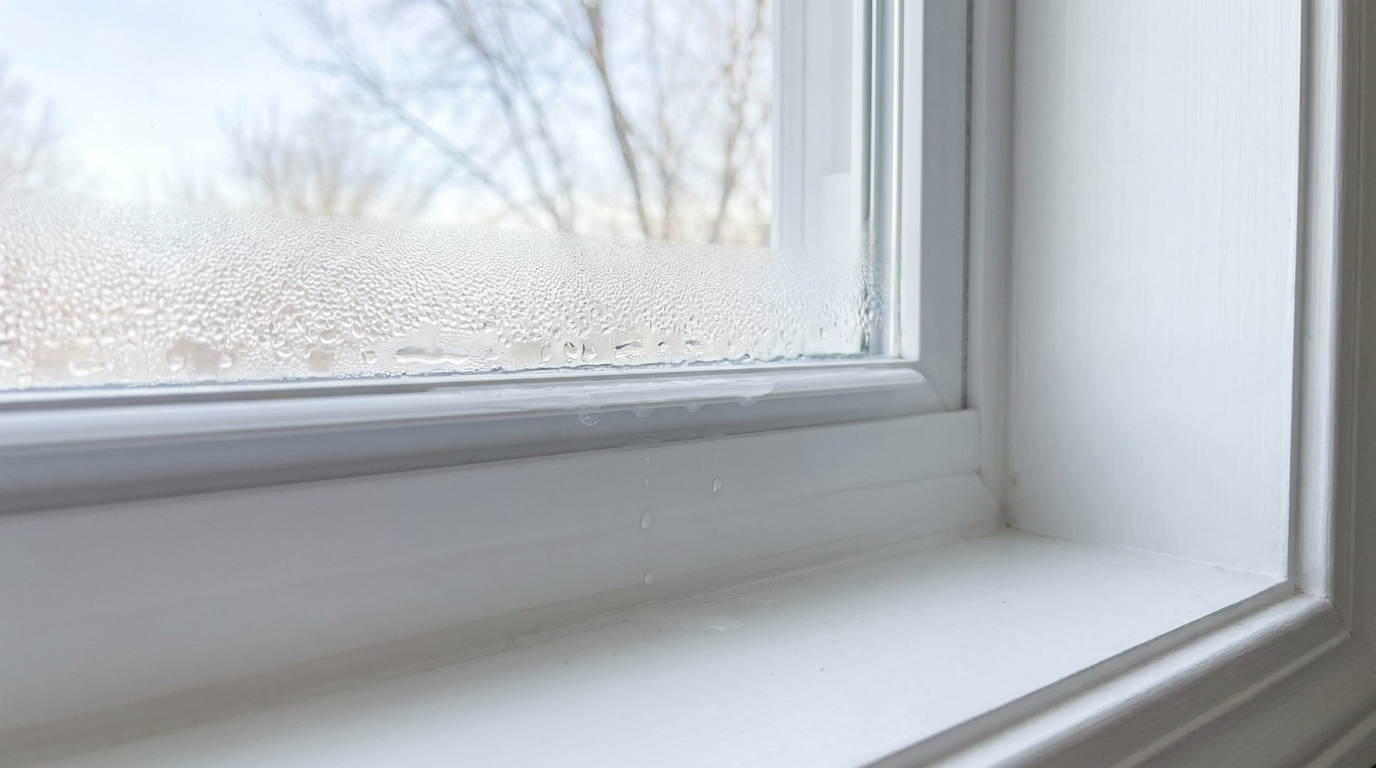
You open the blinds on a cold Raleigh morning and there it is: a band of water along the bottom of the glass, sometimes running down onto the sill. Come July, some of the same windows can be wet on the outside instead. A Triangle home gets both, and they have different causes.
The short answer for the inside: condensation forms when the room-side surface of the glass is colder than the dew point of the air in your house, so the moisture in that air turns to water on the glass. Usually, that makes it a humidity problem rather than a window problem. There are exceptions, though. If you'd rather have someone work out which kind you have, that's what a window inspection is for.
How Do Cold Glass and Dew Point Create Condensation on Raleigh Windows?
Warm air can hold more water vapor than cool air. In its homeowner guide to indoor condensation, the Fenestration and Glazing Industry Alliance (FGIA), an association of window, door and skylight manufacturers, defines the dew point as the temperature at which moisture in the air forms into liquid or ice, and explains that when a surface falls below the dew point, water condenses on it.
On a winter night, the window is that surface: when the room-side face of the glass drops below the dew point of the indoor air, the room's own moisture lands on it. In a technical service bulletin on insulating-glass condensation (IG01, November 2021), glassmaker Cardinal says indoor condensation is usually seen in winter at the bottom edge of the glass and around its perimeter, and sometimes across the whole indoor surface. Once enough forms, gravity carries it to the sill.
Raleigh winters bring the cold half of that equation. The National Weather Service's 1991–2020 daily normals for Raleigh-Durham International Airport put the normal January low at 32°F. That is an average, so individual nights run both colder and warmer.
The timing has a local twist. Andersen's guide to window condensation says that when windows sweat right after the heat comes on, the house has probably absorbed moisture during the humid summer months, and the condensation should disappear after a couple of weeks as that moisture dissipates. In the meantime, wipe the water off the glass and sill rather than letting it sit.
Does condensation mean the house is too cold? Not by itself. It means the glass is colder than the dew point of the room air, and drier air or warmer glass stops it.
What Indoor Humidity Level Prevents Window Condensation in a Raleigh Home?
There isn't one number, because the ceiling moves with the weather: the colder it gets outdoors, the colder the glass. FGIA publishes recommended maximum indoor humidity levels by outdoor temperature, with the house at 70°F. Its top two rows:
- 20°F to 40°F outside: indoor relative humidity of 40% or lower
- 10°F to 20°F outside: indoor relative humidity of 35% or lower
Set that beside the Raleigh-Durham normals and a typical January night falls in the first row. On a night between 10°F and 20°F, the second row applies. So as the weather turns colder, turn the humidity down with it. If you have a whole-house humidifier, its setting is the first thing we'd check.
That ceiling is tighter than the range you'll see quoted for health. The EPA's guide to mold, moisture and your home advises keeping indoor humidity below 60% if possible, ideally between 30% and 50%. Both can be true at once: a reading above 40% can sit inside the EPA's ideal band and still exceed FGIA's ceiling for a freezing night. On the coldest nights, the window sets the limit.
Our advice: measure rather than guess. An inexpensive humidity meter from a hardware store will show where your house sits. Check the rooms where the glass fogs first, and treat the chart as a starting point, not a guarantee.
Do Insulated Glass and Warm-Edge Spacers Stop Condensation in Raleigh?
They reduce it. They don't stop it. Double- and triple-pane glass keeps the room-side pane warmer than single glass, so it can tolerate more moisture in the room before it reaches the dew point. But on a cold enough night, with enough moisture in the room, even good glass can condense.
At the edge of a sealed glass unit, a spacer holds the panes apart, and what it's made of matters. The National Fenestration Rating Council's consumer guide to window spacers says metal spacer systems are common but let heat and cold pass through easily, which risks condensation, while warm-edge spacer systems, which blend metallic and non-metallic materials, cut condensation.
If you're comparing windows, look for a condensation rating. FGIA notes that condensation resistance is rated on three different scales, that manufacturers generally carry only one, and that on each a higher number means better resistance. It also cautions that the ratings are for comparing products, not for predicting whether a window will condense in your home.
New windows can also make condensation more noticeable. Marvin, the window manufacturer, explains in a post on window condensation that older windows let a house breathe, while in today's more energy-efficient windows and houses, humid air can be more easily trapped inside. The same post says new wood, plaster and cement from a remodel or new construction contain a great deal of moisture, and to expect that condensation to disappear after the first cool season. So in a newly built Triangle home, a window that fogs that first season isn't necessarily a bad window.
Can Exhaust Fans and a Dehumidifier Get Rid of Condensation for Raleigh Homeowners?
They can make a real difference, as long as they're aimed at the source. The EPA's guide recommends running the bathroom fan or opening a window when you shower, using exhaust fans or opening windows whenever you cook or run the dishwasher, and venting moisture-producing appliances such as clothes dryers and stoves to the outside where possible.
Combustion is easy to overlook. The EPA notes that combustion appliances such as stoves and kerosene heaters produce water vapor and will increase indoor humidity unless they're vented to the outside. Vent-free gas logs fall into that category, because they aren't vented at all.
Air movement matters, too. FGIA recommends running ceiling fans throughout the house, and adds a tip that sounds backward: open curtains and blinds during daylight hours, because keeping them closed increases the likelihood of condensation.
A dehumidifier suits a space that stays damp after you've dealt with the sources, such as a basement. Two cautions from our side. If every window in the house is fogging, find the source before you buy a machine to fight it. And check the model for cool rooms: ENERGY STAR's dehumidifier guidance notes that frost can form on the coils below 65°F, and suggests considering a model specified for lower temperatures for spaces that typically run that cool.
Why Does Summer Condensation Form Outside the Glass, and How Do You Stop It?
In summer the roles reverse: the moist air is outside, and the glass is the cool surface. In its July 2025 climate summary, the State Climate Office of North Carolina reported that Raleigh's average dew point reached 69.8°F, the highest for any July since 1946.
If your windows are wet on the outside first thing in the morning and dry by midday, that's dew. Cardinal's bulletin lists the conditions behind it: glass colder than the dew point, a clear night sky, still air, high humidity, and highly insulating glass. On a clear night the outer pane can radiate heat to the sky, and with good insulating glass it can cool below the dew point of the outdoor air. Cardinal is explicit that this outdoor condensation is not an indication that the glass or the insulating unit is defective, and that the glass should not be replaced over it.
So how do you stop it? For this kind, we'd leave it alone. In an article on interior and exterior condensation, glassmaker Vitro offers a simple test: if the condensation disappears when the sun comes up and warms the air, the insulating glass is working properly. Vitro also says there is no practical way to eliminate condensation entirely.
The case worth acting on is single-pane glass that sweats outside while the air conditioning runs. Vitro describes this as a problem of non-insulated glass in a building that is very air conditioned compared to the warm, humid summer air, and notes that insulation would prevent it. A thermostat setting that isn't pushing the room as cold narrows that gap; glass that insulates closes it. Either way, keep an eye on the paint on the exterior sill below.
When Does Interior Condensation Mean a Raleigh Window Needs Repair?
Most of the time, it doesn't. Cardinal's bulletin says glass with indoor condensation caused by high room-side humidity should not be replaced. Get the humidity into range first; if the condensation goes away, so does the question. A few patterns, though, can point at the window itself:
- A ring of condensation in the middle of the glass. Cardinal notes that when the two panes of an insulating glass unit touch in the center, winter condensation rings can appear there, and that repair or replacement of the glass may be required if they are touching. It suggests confirming that with the window or glass manufacturer, and notes that high indoor humidity can also cause condensation at the center.
- One window that fogs while its neighbors stay clear. Vitro's list of causes for unexpected interior condensation includes shades that change how air moves across the glass, and air leakage through the framing system. If the curtains aren't the explanation, look at the weatherstripping around that sash. Replacing worn weatherstripping is a repair, not a new window.
- Condensation concentrated on a metal frame, or in a strip around the glass. Andersen's guide says a strip of condensation around the glass is probably a metal part of the window touching both the outside and the inside. That doesn't mean the window is leaking air; it means the window is less energy efficient than a thermally broken one would be. It's a design limit rather than a failure, so the practical fixes are lower humidity now or a thermally broken window later.
Water between the panes of glass is a separate problem, a failed seal, and we've covered it in the common signs your windows need replacing and in how long sealed glass lasts in Raleigh.
Sorting humidity from a leak, a design limit or a failing glass unit is easier with the window in front of you, which is why we start every job with a free on-site inspection. And if it does come to window replacement, ask for the condensation rating and the spacer type in writing, so you're comparing like with like.
How Can You Spot Sill Rot From Years of Condensation on a Raleigh Home?
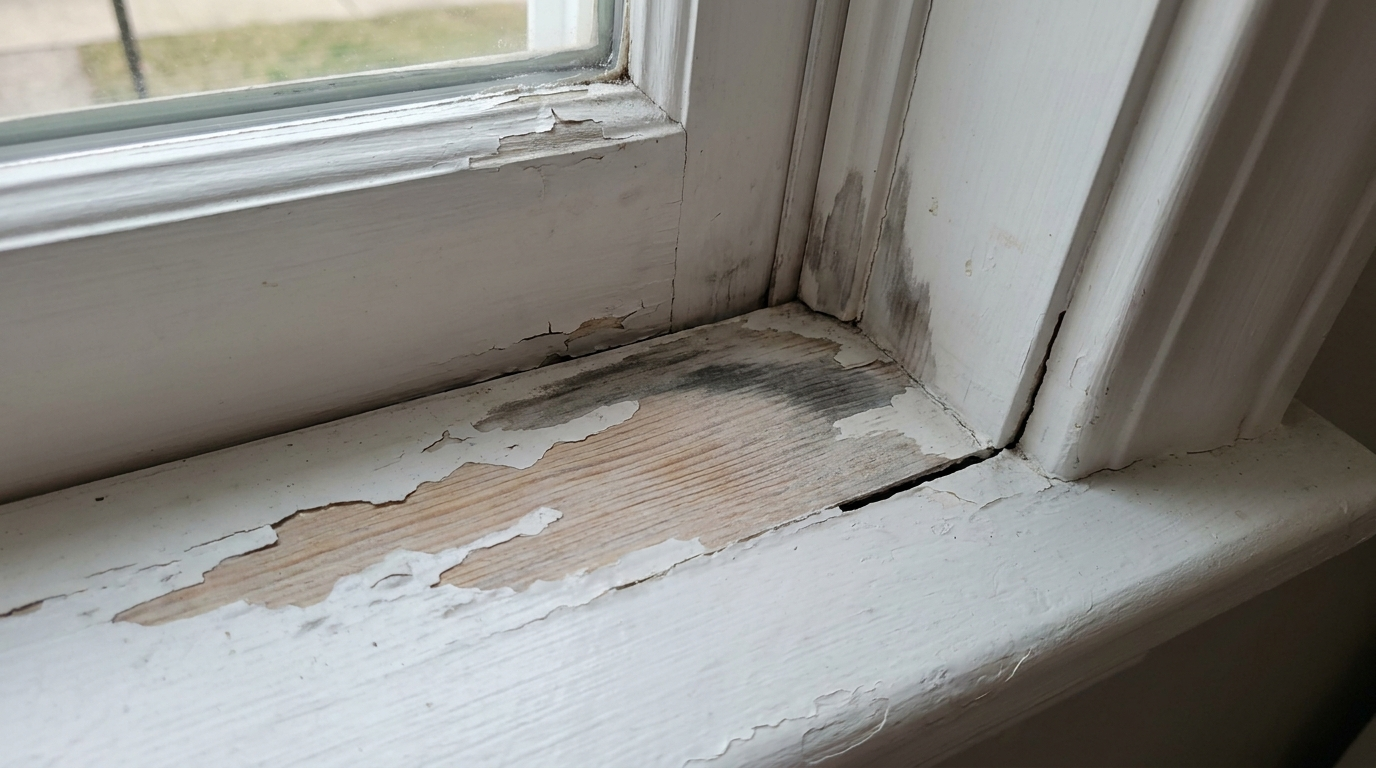
Condensation that runs down the glass has one place to go: the bottom of the window. Over the years, that's where the damage collects, on the bottom rail of the sash, the interior sill and the corners where they meet.
Look for:
- Paint that peels, blisters or cracks on the sash or sill. Andersen's guide notes that too much condensation can cause the paint on a window's sash to peel and can damage the window frame.
- Gray or black staining in the corners, or spots of mildew where water sits.
- Wood that looks swollen, split or cupped, or joints between the sill and trim that have opened up.
- Stains on the drywall or baseboard below the window, or a musty smell that hangs around it.
A vinyl frame won't rot, but the wood sill, trim and framing around it can.
Don't paint over it, either: the EPA's guide says not to paint or caulk moldy surfaces, and that paint applied over moldy surfaces is likely to peel. If you do find mold, the same EPA guide covers cleanup and when to bring in a professional.
Soft wood at a sill is the receipt for a moisture problem, not its cause. Fix the humidity or the leak first, or new wood can go the same way. Then the question is how far the water has traveled, and whether the window is still worth keeping. When rot has reached the frame itself, replacing the window can be cleaner than patching around it.
The Bottom Line, Briefly
- Interior condensation forms when the glass is colder than the dew point of the indoor air. Usually, that makes it a humidity problem rather than a window problem.
- With the house at 70°F, FGIA recommends indoor humidity of 40% or lower at 20°F to 40°F outside, and 35% or lower at 10°F to 20°F. A typical Raleigh January night falls in the first range.
- Insulated glass and warm-edge spacers reduce condensation; they don't stop it. New windows and newly built homes can make it more noticeable at first.
- Exhaust fans, venting dryers and stoves outdoors, a lower humidifier setting and open blinds during the day all help; a dehumidifier suits a space that stays damp.
- Outdoor dew that disappears when the sun comes up means the insulating glass is working properly. Single-pane glass that sweats outside while the air conditioning runs is the case worth acting on.
- A ring in the middle of the glass, one window that fogs while its neighbors stay clear, or condensation on a metal frame can point at the window itself. Peeling paint, staining or swollen wood at the sill are signs of damage.
Get the humidity right first. If the condensation keeps coming back in the same place, that's the window asking for a closer look.