How Long Do Windows Last in Raleigh? A Homeowner's Guide
WindowsBaker Home Exteriors
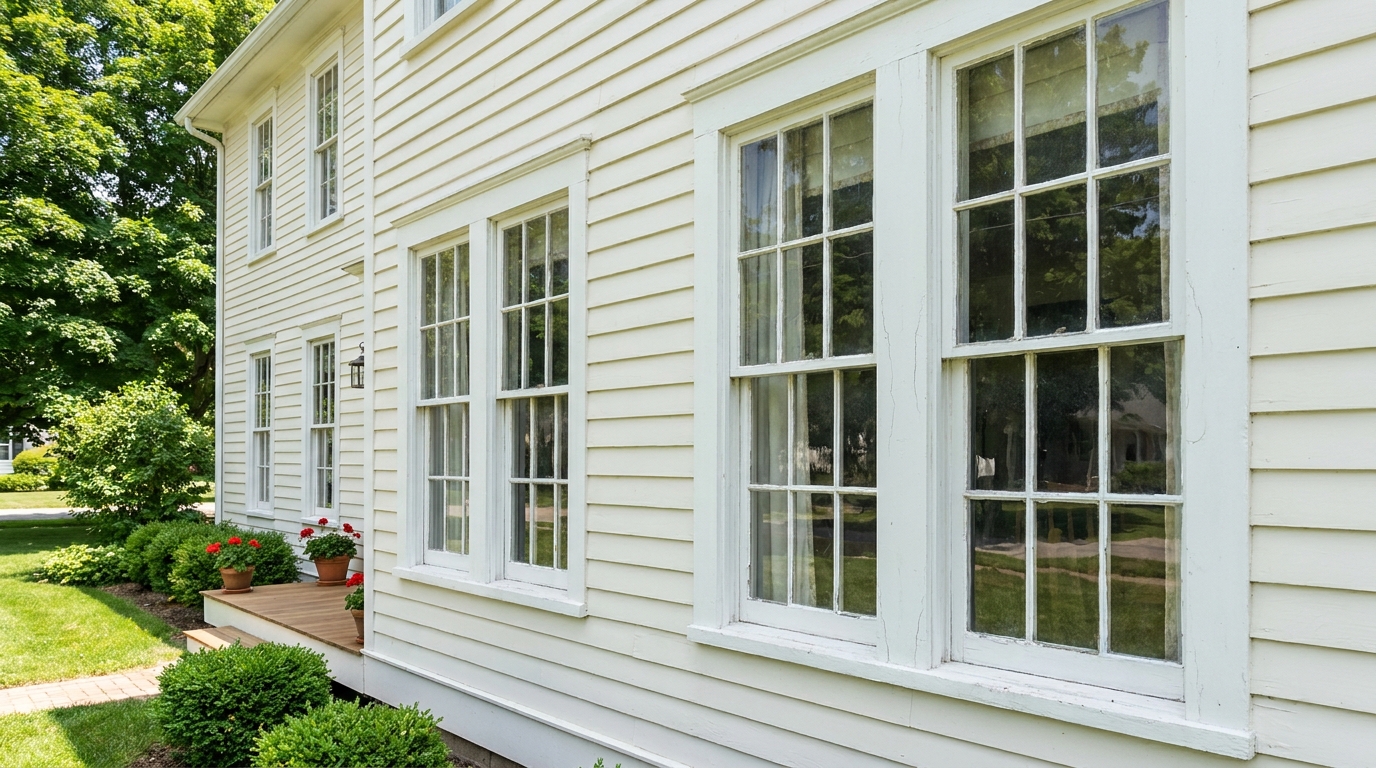
Ask a room full of homeowners how old their windows are and the answers scatter wildly. In one discussion running to more than 250 replies, the three highest-voted answers came from people whose windows were 161 years old, 146 years old, dated to 1912, and 37 years old. The ones who said why were in no hurry to change them: the owner of the 37-year-old units saw no reason to replace them “unless they rot or leak a lot of air,” and reckoned they might go another twenty years.
Further down the same thread, someone else mentioned having ten windows under a decade old that leaked like a sieve, two of them with standing water between the panes.
Both of those are normal. That is the honest answer to how long windows last, and it is why the number on the calendar is the least useful thing you can know about them. If you want a straight read on where yours actually stand, a window inspection in Raleigh will tell you more in twenty minutes than the install date will.
This guide covers the service life you can expect from each part of a window in the Triangle, what our climate does to shorten it, and how to tell an old window from a finished one.
How Long Do Windows Last in a Raleigh Home?
Somewhere between fifteen and fifty years. That range is wide enough to sound like a dodge, but the width is the honest answer — This Old House puts most residential windows in exactly that band, and where a given window falls inside it has far more to do with material, installation and exposure than with the calendar.
Any published range is worth holding loosely, and not only because it is wide. It is a national average across every frame material, quality tier and climate in the country, and it treats the window as one object when it is really three things with three different lifespans: a frame, a sash that moves, and a sealed glass unit. Those parts do not fail on the same schedule, and in most homes the glass gives out first while the frame around it is still perfectly sound.
What that range does not account for is installation. Two identical windows fitted into the same house on the same day can be twenty years apart in service life depending on how they were flashed, shimmed and sealed at the opening. It is the single largest variable in the whole equation and the one that is invisible once the trim goes on.
For a Raleigh home, treat the middle of that band as a planning figure rather than a deadline — a well-installed window here can comfortably beat it.
Which Window Frame Materials Last Longest in Raleigh?
Frame material sets the ceiling on how long a window can last. Everything else decides whether it gets there.
| Frame material | Commonly published service life |
|---|---|
| Fiberglass | 30 to 50 years |
| Vinyl | 20 to 40 years |
| Wood | 15 to 30 years |
| Aluminum | 15 to 30 years |
Those figures are This Old House’s, and the spread inside each one matters more than the gap between them — published guides do not fully agree with each other on the narrower bands. In the Triangle, the deciding factor is usually how a material handles heat and moisture rather than how it handles time.
Fiberglass is the most dimensionally stable of the four. It expands and contracts at close to the same rate as the glass it holds, which is why it tends to sit at the top of the range — the sealed unit inside it is under less strain through a Carolina summer.
Vinyl performs well here and is the most common replacement frame we see, but it moves more with temperature than fiberglass does. Dark exterior colors absorb noticeably more heat, and on a west- or south-facing elevation that extra movement is worked into the frame and the seal every day for decades.
Wood has the widest spread of any material on the list, because its lifespan is almost entirely a function of maintenance. A wood window that is kept painted and kept dry can outlast everything else on this table — the hundred-year-old sashes still in service in older Raleigh neighborhoods are wood. One that is allowed to hold moisture at the sill will rot out in a fraction of its rated life.
Aluminum conducts heat readily, which drives condensation at the frame in humid conditions and puts steady moisture where you least want it.
We have kept prices out of this section, because the longest-lasting material is not always the right one for a given house. If you are weighing that trade-off, we have written separately on what window replacement costs in Raleigh.
What Shortens Window Lifespan in Raleigh’s Humid Summers?
Heat and moisture, working on the parts of a window you cannot see.
Raleigh gives windows a genuinely demanding summer: long stretches of high heat with humidity to match, followed by afternoon thunderstorms that drop the temperature quickly. That daily swing is the mechanism. The materials in a window expand through the afternoon and contract through the evening, and every joint, seal and sealant bead absorbs that movement.
The sealant is where it shows first. In a review of insulating glass edge seals, researchers at Lawrence Berkeley National Laboratory note that “the strength of thermoplastic PIB decreases rapidly as temperature increases” — which is precisely why a sealed unit uses a second sealant around the perimeter rather than relying on the primary one alone. The same review lists the environmental stresses a unit absorbs across its service life as “solar radiation, temperature differences, wind loads” and barometric pressure changes. A Raleigh summer supplies all four, most days.
Direct sun does the other half of the work. A west-facing window takes the hottest, longest exposure of the day, and on most houses that elevation is where we find the first failed seals, the first chalky vinyl and the first cracked glazing putty — often a decade ahead of the north side of the same home.
Indoor moisture matters too, and it is the part homeowners can actually control. NC State Extension advises that “humidity levels should be maintained below 60%,” with optimal levels “between 30-50%,” and notes that condensation on windows “may be a sign of high indoor humidity.”
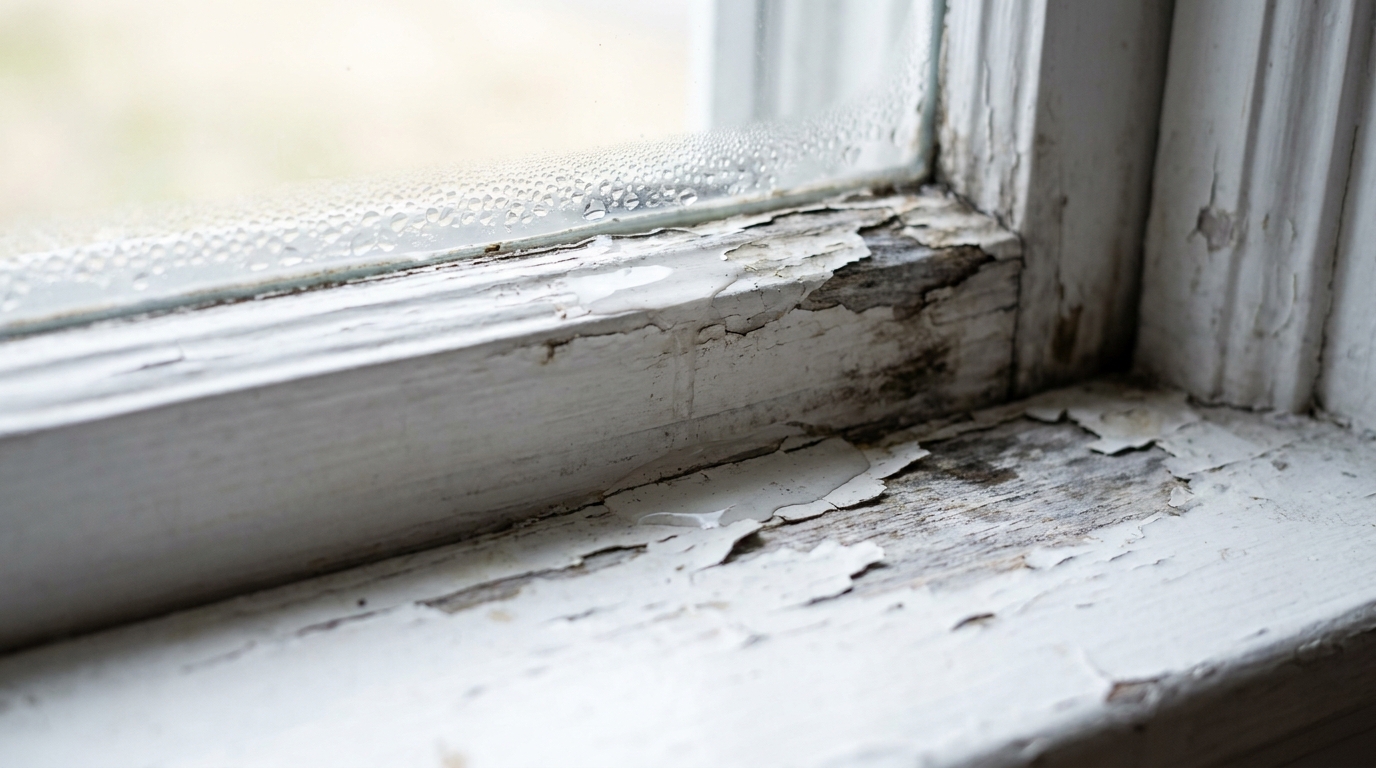
That guidance is about air quality rather than windows, but the overlap is the useful part. In our own work it is persistent moisture sitting on sills and sash bottoms that starts rot in a wood window and stops a painted surface holding.
How Long Do Raleigh Window Seals and Insulated Glass Units Last?
Shorter than the frame holding them. On most homes, the sealed glass unit is the first part of the window to fail, and it usually fails alone.
A modern double-pane window is an insulated glass unit: two panes held apart by a spacer bar, with a desiccant inside the spacer that absorbs stray moisture, and sealant around the perimeter keeping the outside out. The Berkeley review is clear about how that runs down over time. Desiccants “prolong the windows’ service life by adsorbing moisture and organic vapor until the desiccant is saturated” — but “the capacity of desiccants is limited, and any water vapor infiltrating the interpane space after the desiccant is saturated can result in fog on the internal surface of the IG unit.”
That is the whole failure in two sentences. The seal does not burst. It admits water vapor slowly for years, the desiccant quietly uses up its capacity absorbing it, and the day it runs out is the day the glass fogs. The visible symptom arrives long after the process started.
Two practical consequences follow, and neither is obvious.
The first is that a fogged unit is a glass problem, not a window problem. In most cases the sealed unit can be replaced on its own, leaving the existing frame and sash in place — a distinction worth raising with anyone who quotes you for whole-window replacement on the strength of foggy glass. Whether it is worth doing depends on the age and condition of the frame.
The second is that seal failure is not reliably visible. Home inspectors who deal with this describe a failed seal as something that “is not always readily visible in all weather conditions and may be more obvious in winter months or during wetter weather,” and note that cracked or displaced desiccant strips and spacer bars indicate a failed seal even with no fogging on the glass at all. A window that looks fine on a dry August afternoon can be a different window in January. It is one of the better arguments for having someone check the glass and frames properly rather than judging from the kitchen on a clear day.
Does Raleigh Storm Damage Shorten a Window’s Working Life?
It can, and rarely in the way homeowners expect.
Raleigh sits inland, so the storm risk here is not the coastal wind-borne debris problem that the Lowcountry deals with. It is convective: the NC State Climate Office notes that during the warmer months our weather “is driven by more local-scale convective processes,” and that these storms “sometimes also produce hail and tornadoes or damaging straight-line winds.”
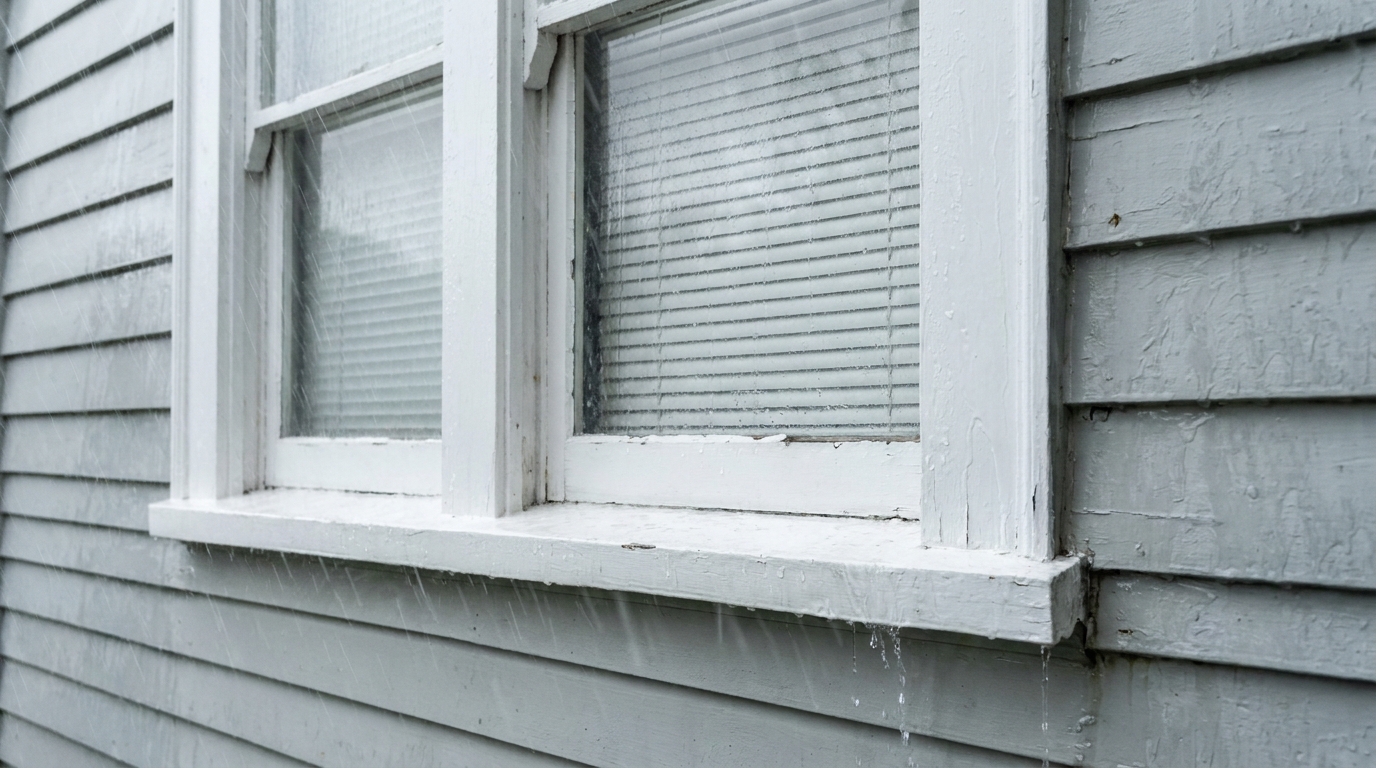
Dramatic damage announces itself. A cracked pane or a sash knocked out of square gets dealt with immediately. The damage that shortens a window’s life is the kind nobody logs — a wind event that racks the frame slightly in its opening, hail that pits and hardens the exterior sealant, or wind-driven rain forced sideways into a joint that sheds vertical rain perfectly well. Wind loading is one of the environmental stresses Berkeley lists as acting on a sealed unit throughout its service life, and a storm is simply a very large dose of it in a very short time.
None of that shows up as a broken window. It shows up three or four years later as a fogged unit on the storm-facing elevation, a sash that has started to bind, or a stain on the drywall below a sill. If a significant storm has been through, the useful move is to look at the windows on the exposed side while you are already having the roof checked — not because they are likely broken, but because that is when small damage is cheapest to correct. Where the frame itself has moved or the unit has taken a real hit, a free window inspection tells you whether it needs replacing.
How Do Raleigh Homeowners Tell an Aging Window From a Failing One?
This is the distinction that actually decides the money, and almost nothing written about window lifespan draws it.
An aging window still does its job, just less gracefully than it used to. It is stiff to open. The finish is tired. It is single-glazed in a house where everything else has been updated, so the room runs cold in January. These are comfort and efficiency complaints — real, worth solving eventually, not urgent. The homeowner with 37-year-old windows who saw no reason to replace them “unless they rot or leak a lot of air” was describing aging windows, and was right to leave them alone.
A failing window has stopped performing a function it is supposed to perform. Water is getting past it. The frame or sill has soft rot, which is a structural problem rather than a window problem. The sash will not lock, so the window is no longer a secure closure. The sealed unit has lost its gas fill and the glass no longer insulates. These do not improve, and several of them get more expensive the longer they run.
The test we use is simple: is the window still keeping weather and intruders out, or has it stopped? Comfort problems can wait for a good moment. Water and security cannot.
Two honest caveats. Rot is the one symptom that should never be filed under “aging” — by the time it is soft to a screwdriver it has usually reached framing you cannot see from outside. And as above, a failed seal can hide from you entirely depending on the day you look at it.
If you want the symptom-by-symptom version, we have set out the full list of replacement signs separately. Where the answer does come out as replacement, the case usually rests on comfort and running costs rather than age alone, and we have covered where the energy savings actually come from in its own piece.
The Bottom Line on Window Lifespan in Raleigh
A Raleigh window will typically give you somewhere between fifteen and fifty years, fiberglass and vinyl toward the top of that, wood anywhere at all depending on how it has been looked after. The sealed glass will usually tire before the frame does, and it can often be dealt with on its own.
But the date on the sticker is the weakest predictor in the whole exercise. Windows a century old are still working in this city, and windows fitted in the last decade are already failing in it. What separates them is how they were installed, which elevation they face, and whether moisture was ever allowed to sit on them — not how many birthdays they have had.
So the question worth asking is not how old your windows are. It is whether any of them have stopped doing their job, and whether the ones that have are worth repairing or replacing across the whole Raleigh home. That is a judgment best made with someone looking at the actual sashes and seals, in daylight, from both sides.
If you would like that settled properly, we will come and look. A free inspection tells you which of your windows are simply old and which ones are genuinely finished — and on plenty of Raleigh homes, the answer is far fewer than the sales pitch suggested.