Vinyl Siding Cost in Raleigh: What to Expect
SidingBaker Home Exteriors
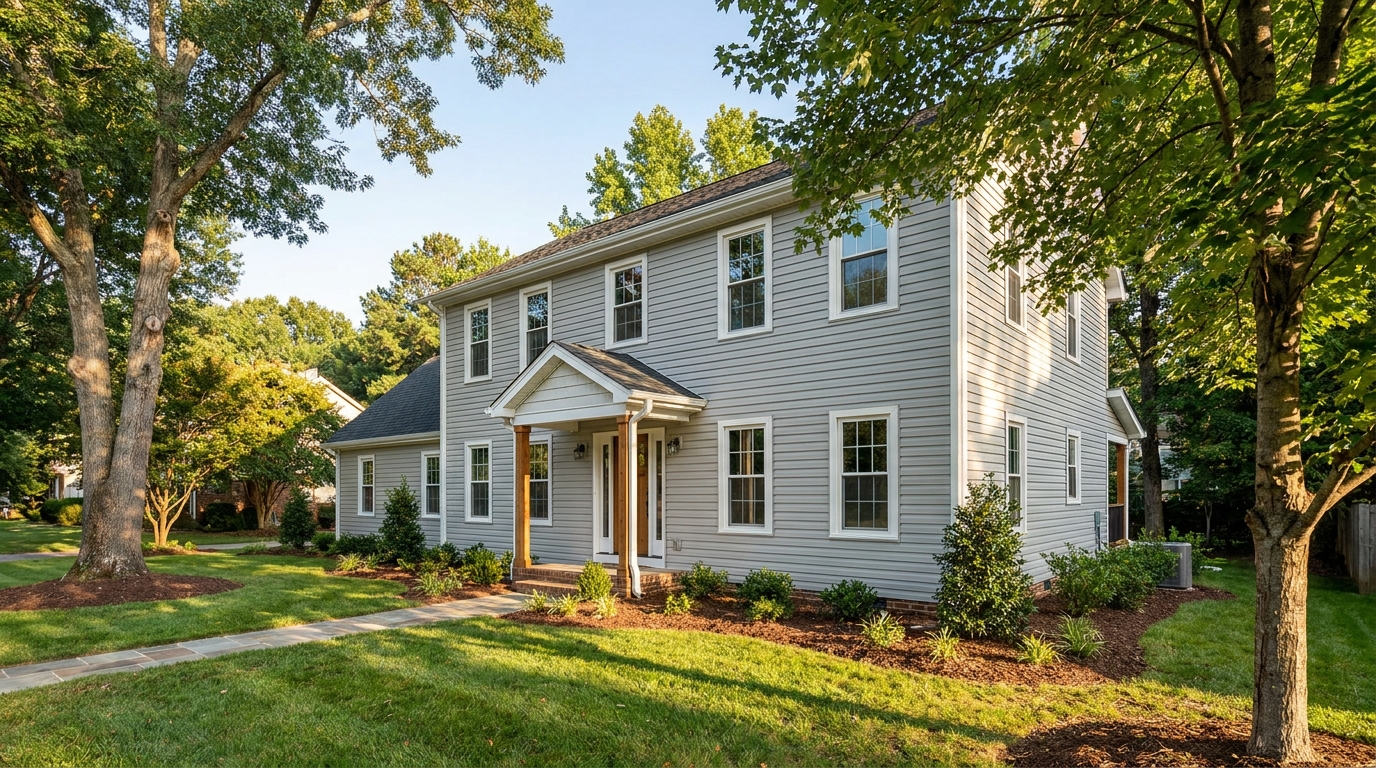
Vinyl siding is the most common exterior cladding in the Triangle for a straightforward reason: it costs less than nearly every alternative and it asks very little of you afterward. But “vinyl siding” covers a range of products that can differ in installed price by three times, which is why two Raleigh quotes for the same house can look nothing alike.
The variable that explains most of that gap is grade — the thickness and quality of the panel itself. Once you know which grade a quote is built on, you can compare bids honestly.
Every figure here is national industry data rather than Baker pricing, because square footage, wall complexity, and what we find behind the old siding decide the real number.
How Much Does Vinyl Siding Cost in Raleigh?
Nationally, vinyl siding replacement runs about $3 to $12 per square foot installed, according to NerdWallet’s cost analysis. Homewyse puts basic installation at $7.32 to $12.51 per square foot as of 2026.
For a typical 2,000-square-foot Raleigh home, that puts most projects somewhere between $7,000 and $26,000 depending almost entirely on which grade of panel you choose.
Note that siding is measured by wall area, not by the home’s floor area, and the two are rarely the same number. A two-story home has considerably more wall surface than a ranch of identical square footage, and gables, dormers, and bump-outs all add area that never appears in a real estate listing. Any quote worth comparing starts with a measured wall area.
We install siding for Raleigh-area homes specifically. If you are weighing materials more broadly before you get to price, our guide to the best siding options for a Raleigh home covers the choice itself.
Which Vinyl Siding Grades Fit Raleigh Homes, and What Do They Cost?
Grade is the single biggest lever on price, and it is where most of the confusion between quotes lives. Panel thickness is the shorthand.
| Grade | Thickness | Expected life | Installed per sq ft | 2,000 sq ft total |
|---|---|---|---|---|
| Economy / builder’s | up to 0.40 mm | ~15 years | $3.50 – $5.50 | $7,000 – $11,000 |
| Standard residential | 0.42 – 0.44 mm | 20 – 25 years | $4.50 – $7.00 | $9,000 – $14,000 |
| Thick / premium | 0.46 mm+ | 30+ years | $6.00 – $10.00 | $12,000 – $20,000 |
| Insulated | varies | 30+ years | $7.00 – $13.00 | $14,000 – $26,000 |
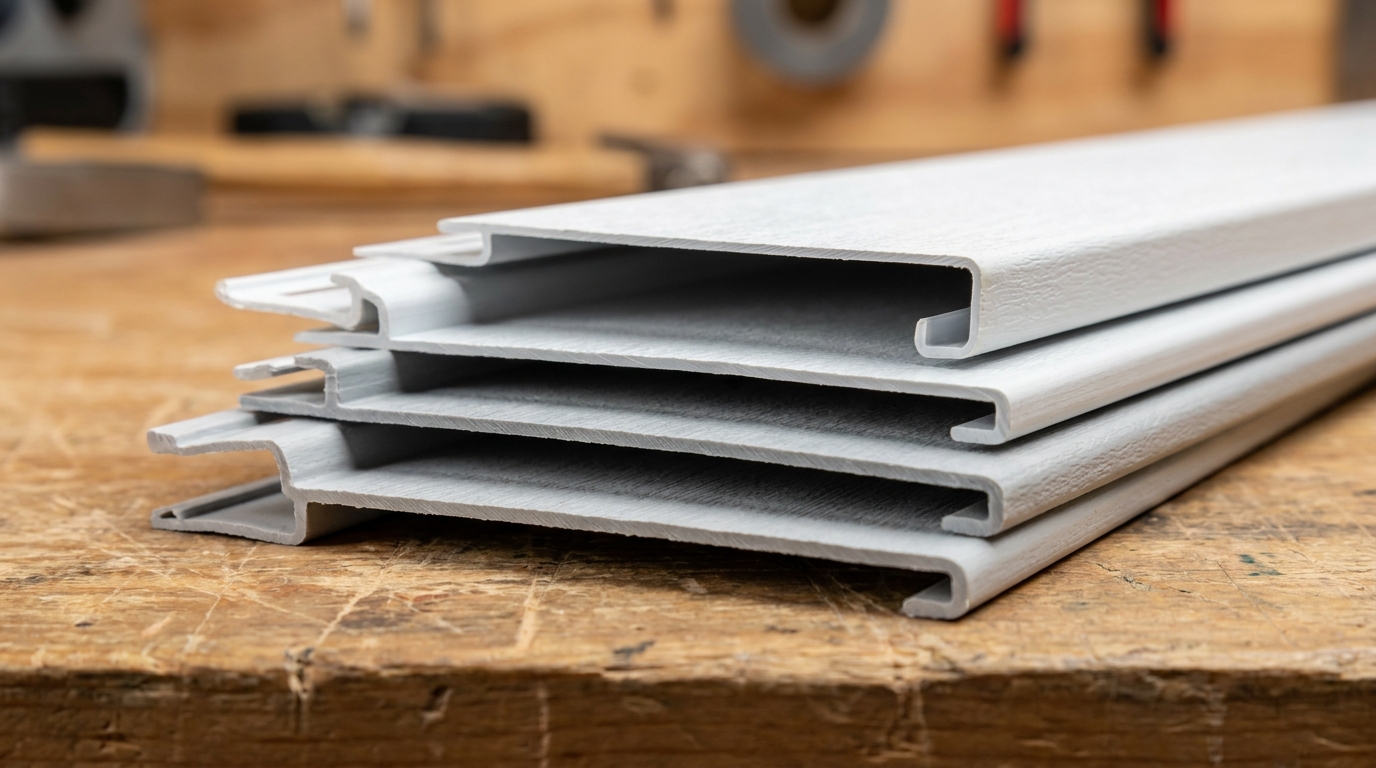
For most Raleigh homes we would steer away from the economy tier unless the property is a short-term hold. Thin panels are more prone to warping and to visible movement, and the Triangle’s summer heat is exactly the condition that exposes that. The step from economy to standard is usually a few thousand dollars on a whole house and it buys most of the durability difference.
Premium grade earns its cost on two counts: rigidity, which keeps walls looking flat rather than wavy, and better colorfastness through years of North Carolina sun.
How Do Vinyl Siding Styles Change the Price on a Raleigh Home?
Profile matters less than grade but more than most homeowners expect.
Standard horizontal lap siding, the familiar double-4 or double-5 profile, is the volume product and the baseline price. Dutch lap adds a decorative groove and typically carries a small premium. Board-and-batten vertical siding costs more to install because it requires more furring and careful alignment, and it is increasingly used as an accent on Triangle homes rather than for a whole elevation.
Shake and scallop panels are the expensive end. They are usually specified for gables, dormers, and entry accents precisely because covering a whole house in them gets costly fast.
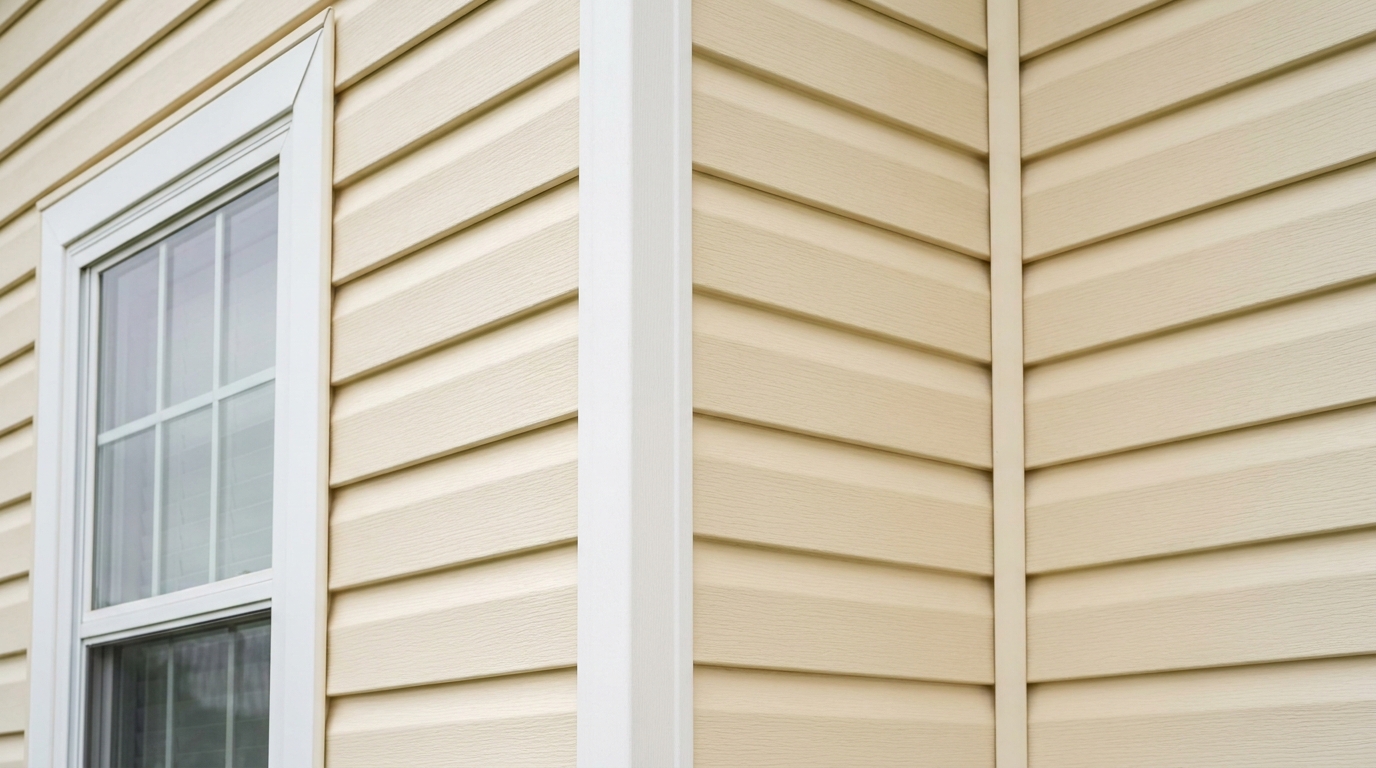
Trim is the line homeowners forget. Corner posts, J-channel, window and door surrounds, soffit and fascia all price separately, and a home with many windows carries meaningfully more trim work than its wall area suggests. Two houses with identical square footage can differ by thousands on trim alone.
How Does Your Raleigh Home’s Square Footage Change Vinyl Siding Prices?
Cost scales with wall area, but not in a straight line, and the direction of the curve is in your favor on bigger jobs.
Mobilization costs — setup, scaffolding, disposal, crew travel — are largely fixed. Spread across a larger home, they shrink per square foot. A small ranch often carries a higher effective per-foot rate than a large two-story simply because the fixed costs have less area to absorb them.
Height works the other way. Anything above the second story needs staging or lifts, which slows the crew and adds cost per foot on the upper elevations. A three-story home is not simply 50 percent more than a two-story.
Complexity is the multiplier that surprises people most. Every inside and outside corner, every window return, every roofline intersection is a cut, a fit, and a piece of trim. A simple rectangular home with eight windows and a large, articulated home of the same wall area are genuinely different jobs.
What Labor Costs Should Raleigh Homeowners Expect for Siding Installation?
Labor is roughly half of a vinyl siding project, which is why the cheapest bid is so often the one worth questioning.
Nationally, siding labor runs about $2 to $5 per square foot according to NerdWallet, and Hover puts the average closer to $3.70. On a 2,000-square-foot job that is roughly $4,000 to $10,000 of the total before a single panel is paid for.
What that labor covers is worth spelling out: removing and disposing of the old siding, inspecting and repairing the sheathing underneath, installing a weather-resistive barrier, then hanging panels and detailing all the trim.
The sheathing step is where honest quotes separate themselves. Vinyl siding hides what is behind it, and Raleigh homes from the 1970s through the 1990s regularly turn up soft sheathing around windows and at grade once the old siding comes off. A quote that makes no mention of what happens if rot is found is not a complete quote. Ask for a per-sheet rate up front, so the discovery is a known price rather than a negotiation mid-job.
Vinyl also has to be hung correctly rather than tightly. Panels must be able to move with temperature, nailed in the center of the slot and never driven home. Nail vinyl tight in a Raleigh July and it will buckle by the following summer. That is an installation error, not a product defect, and it is the most common one there is.
Which Extras Raise the Price of Vinyl Siding in Raleigh?
Several items sit outside the base price and belong in any real budget.
Rotted sheathing replacement is the most common and is priced per sheet. Soffit and fascia are frequently replaced at the same time, since the access is already there and matching later is difficult. House wrap is standard on quality installs and should be itemized. Old siding disposal is priced by volume, and removing more than one existing layer costs more.
Two Raleigh-specific items are worth naming. First, homes built before 1978 may have asbestos-containing siding or lead paint, and both require specialized handling that adds real cost. Second, many Triangle neighborhoods carry HOA architectural review, and color and profile approval should happen before an order is placed rather than after.
Finally, if the plan is a partial re-side, matching existing panels is often impossible. Vinyl colors fade with UV exposure and product lines are discontinued regularly, so a partial job can look like a partial job permanently.
Is Insulated Vinyl Siding Worth Its Higher Price on a Raleigh Home?
Insulated vinyl carries the largest price premium in the category — roughly $7 to $13 per square foot installed against $4.50 to $7 for standard — so it deserves a straight answer rather than a sales one.
The marketing case is energy savings. The measured case is more modest. Research conducted for the U.S. Department of Energy on insulated siding retrofits found that insulated vinyl “at best, achieves R-2 to R-3 with EPS foam,” and noted that it “does not provide any integrated drainage for water.” R-2 to R-3 is a real improvement over the effectively zero R-value of standard vinyl over sheathing, but it is a fraction of what wall-cavity insulation delivers, and it will not by itself transform a Raleigh energy bill.
Where insulated vinyl does earn its money is less about the energy label. The foam backing makes panels noticeably more rigid, so walls look flatter and straighter, the siding sounds and feels more solid, and it dampens noise. Those are real benefits, and for many homeowners they justify the upgrade on their own terms.
Our honest guidance: if you are choosing insulated vinyl for the look and rigidity, it is a good buy. If you are choosing it purely to cut cooling costs in a Raleigh summer, the payback period is long, and the same money spent on attic insulation and air sealing will do considerably more. The federal tax credit for insulation and air sealing covers that work and not siding, which is itself a signal about where the measurable savings sit.
How Does Vinyl Siding Cost Compare to Fiber Cement in Raleigh?
Fiber cement is vinyl’s main competitor in the Triangle, and the comparison is closer than the headline numbers suggest.
Installed, fiber cement runs roughly $4.50 to $11.25 per square foot against vinyl’s $3 to $12. The ranges overlap substantially — premium insulated vinyl and mid-grade fiber cement can land in the same place.
The real differences are elsewhere. Fiber cement is heavier and harder to work, so labor runs higher, and it needs repainting periodically where vinyl does not. In exchange it is more impact-resistant, non-combustible, and generally viewed as the more premium finish, which shows up in appraisals and buyer perception on higher-value Raleigh homes.
Vinyl wins on upfront cost and on maintenance. Fiber cement wins on durability and perceived quality. Neither answer is universally right — it depends on the home’s price tier and how long you plan to own it. Our James Hardie siding project shows what the fiber cement option looks like on a Triangle home.
Does New Vinyl Siding Pay Back at Resale in Raleigh?
Siding replacement is consistently among the better-returning exterior projects, though the honest framing is that it recovers much of its cost rather than making money.
Industry remodeling cost-versus-value research has generally placed vinyl siding replacement in the region of 60 to 80 percent cost recovery at resale, with the exact figure moving year to year and by market. Fiber cement typically recovers slightly more.
The part that does not appear in the percentage is often worth more. Siding is the first thing a buyer sees, and failing siding reads as deferred maintenance across the entire home — it invites questions about the roof, the windows, and the structure. In the Triangle’s market, a home with tired, chalky, or warped siding tends to sit longer and attract lower offers regardless of its condition elsewhere.
The strategic read: replacing siding purely as an investment rarely makes sense. Replacing it because it is failing, and getting most of the money back at sale, usually does.
The Bottom Line on Vinyl Siding Cost in Raleigh
For most Raleigh homes, budget somewhere between $9,000 and $20,000 for a quality vinyl siding replacement — standard to premium grade on a typical 2,000 square feet of wall area. Economy panels bring that down and cost you in longevity. Insulated brings it up and buys rigidity more than energy savings.
The two questions that will tell you most about a quote: which grade is it based on, and what happens if rotted sheathing turns up. A bid that is vague on either is not comparable to one that is clear on both.
If you want a measured wall area and a grade-by-grade breakdown for your own home, our Raleigh siding team will walk the exterior and put real numbers against each option. Schedule a free inspection and we will show you where the money actually goes.