Half-Round vs K-Style Gutters in Greensboro, NC: Which to Pick?
GuttersBaker Home Exteriors
Most Greensboro homes have K-style gutters, and most of them should. But drive through Fisher Park or Irving Park and you will see half-round copper on houses where anything else would look wrong — and on those homes, the choice is not really about drainage.
The decision comes down to three honest trade-offs: how much water each shape carries, what each costs to install, and whether the look matters enough to pay the difference. Here is how they actually compare on a Triad home.
What Are Half-Round Gutters, and Which Greensboro Homes Suit Them?
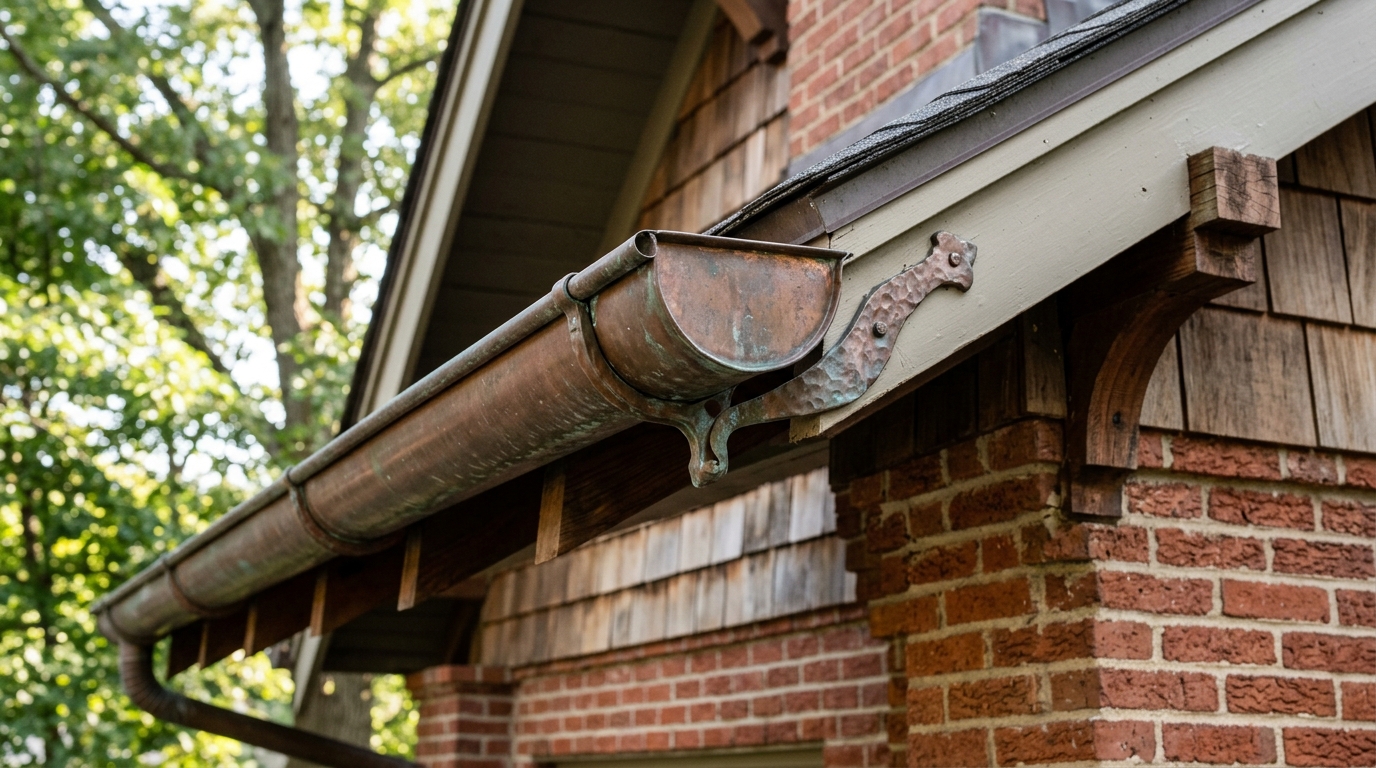
A half-round gutter is exactly what it sounds like — a semicircular trough, the original gutter profile, hung below the roof edge on brackets rather than fastened flat against the fascia.
Because they cannot sit flush to the fascia board, half-rounds need hangers or brackets at regular intervals. That is a real cost and labor difference, not a detail.
They suit Greensboro homes in three situations. Historic and period architecture is the strongest case — Colonial Revival, Tudor, Craftsman, and the older houses in Greensboro’s established neighborhoods were designed when half-round was standard, and K-style on them reads as an anachronism. Copper installations, where the gutter is meant to be seen and to develop a patina, almost always use half-round. And homes under historic district guidelines, where the profile may not be a free choice at all.
If your home is a 1990s build in a newer subdivision, half-round will look like an expensive decision that nobody asked for. That is not a knock on the product — it is a mismatch.
How Do K-Style Gutters Differ on Greensboro Homes?
K-style is the profile almost every modern American home has: a flat back that fastens directly to the fascia, with a decorative front face whose ogee curve loosely resembles crown molding.
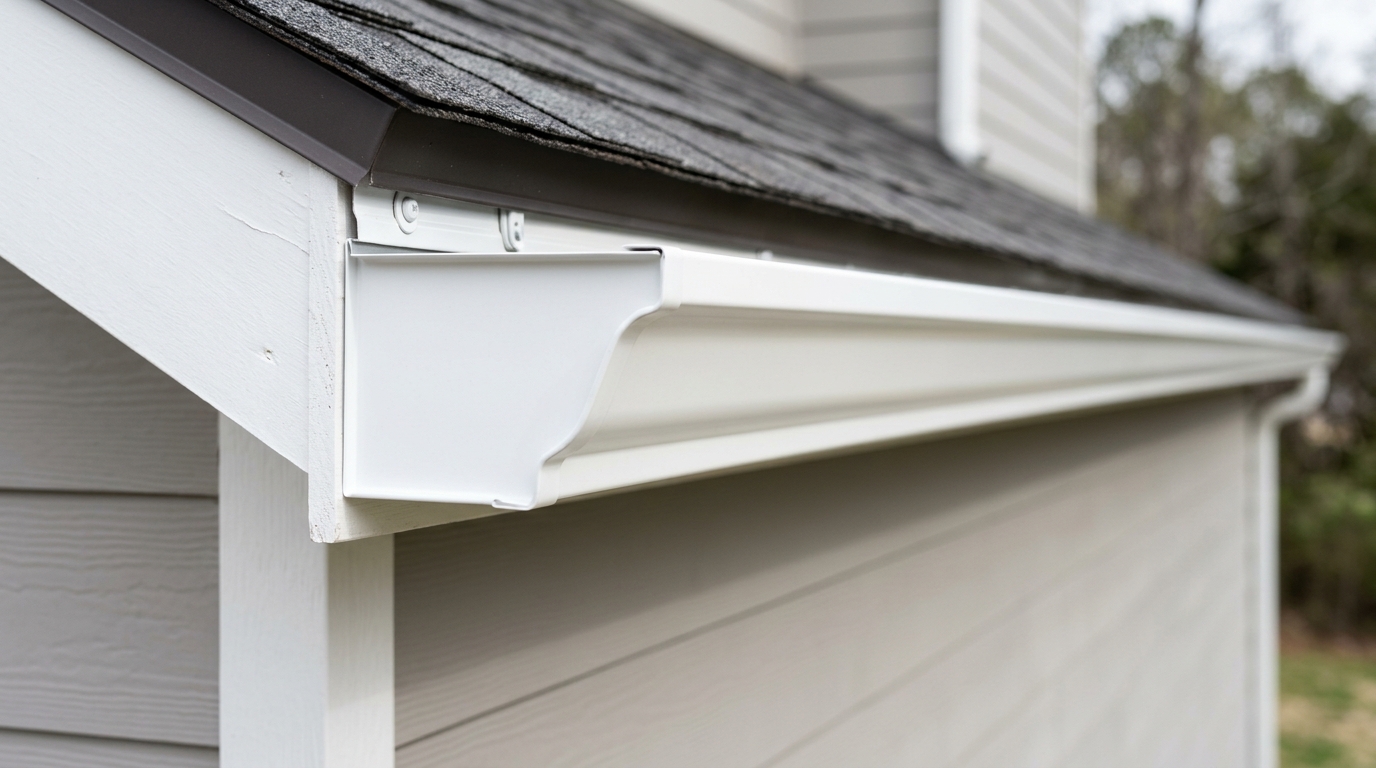
Two consequences follow from that flat back. First, installation is simpler and cheaper — the gutter screws straight to the board, no brackets required. Second, the shape holds substantially more water than a half-round of the same nominal width, because the cross-section is closer to a rectangle than a semicircle.
K-style is also what seamless gutter machines produce on site, which is how most residential gutter work is done now. A crew rolls the profile to the exact length of each run, so a whole elevation has no joints except at corners and outlets. Fewer joints means fewer leaks, and that is a genuine durability advantage over sectional gutter of any profile.
The trade-off is the shape itself: those inside angles where the decorative front meets the bottom collect grit and debris that a smooth curve would carry along.
Which Half-Round Gutter Material Suits Greensboro: Copper, Aluminum, or Steel?
Material changes the cost of a half-round system more than the profile does.
Aluminum is the practical default. It will not rust, it is light enough for straightforward bracket mounting, it comes in a range of finishes, and it is the least expensive half-round option. For a Greensboro homeowner who wants the profile without the premium, this is the answer.
Copper is the reason most people want half-round in the first place. It is extremely long-lived — properly installed copper is measured in generations, not decades — and it weathers from bright penny to brown to verdigris. It is also several times the cost of aluminum, requires soldered joints and a crew who can do that work, and it is worth enough as scrap that theft is a real consideration on unoccupied properties.
Galvanized or painted steel sits in between: stronger than aluminum, better in a hail event, and vulnerable to rust once the coating is compromised at a cut edge. It is the least common of the three on residential work here.
Our comparison of copper versus aluminum gutters goes deeper on that specific material choice, and our overview of the best gutter materials covers the full range.
Do Half-Round Gutters Carry Enough Water for Greensboro Downpours?
This is the practical question, and the honest answer is: usually yes, if they are sized correctly — but they start from a disadvantage.
A half-round holds less water than a K-style of the same nominal size. A 6-inch half-round has a smaller cross-section than a 6-inch K-style, simply because a semicircle encloses less area than that ogee profile does.
Greensboro’s rainfall pattern makes this worth thinking about rather than waving away. The Triad gets intense summer convective storms that drop a lot of water in a short window, and it is peak intensity, not annual total, that overwhelms a gutter.
The fix is straightforward and it is what a competent installer will propose: size up. A 6-inch half-round in place of a 5-inch, and enough downspouts. Downspout count and placement matter as much as trough size — a correctly sized gutter with too few outlets still overflows, because the water has nowhere to go.
So half-round can absolutely handle a Greensboro storm. It just needs to be specified deliberately rather than swapped in at the same dimension.
How Do Half-Round and K-Style Gutter Costs Compare in Greensboro?
Half-round costs meaningfully more, and the gap is wider than most homeowners expect. National averages put half-round around $28 per linear foot installed, against roughly $6 to $12 per linear foot for standard seamless aluminum K-style. Industry guidance often describes the premium as 50% to 100%, but on aluminum-versus-aluminum that understates it — at those figures half-round can run two to three times the K-style rate, and copper goes further still.
Every dollar figure here is national industry data rather than Baker pricing — a real number for your home depends on linear footage, height, material and how many corners and outlets your roofline needs.
The premium comes from four places, and none of them is margin:
- Brackets. Half-round needs hangers; K-style does not.
- Labor. More parts, more precise alignment, slower installation.
- Fabrication. Seamless K-style is rolled on site from a machine most crews own. Half-round often is not, which means ordered lengths and more joints to seal or solder.
- Waste. Half-round runs produce more offcut than K-style on the same roofline.
Copper compounds all four. If you are pricing copper half-round against seamless aluminum K-style, expect a multiple rather than a percentage.
Are Half-Round Gutters Harder to Maintain on a Greensboro Home?
Here the half-round wins, and it is a genuine functional advantage rather than an aesthetic one.
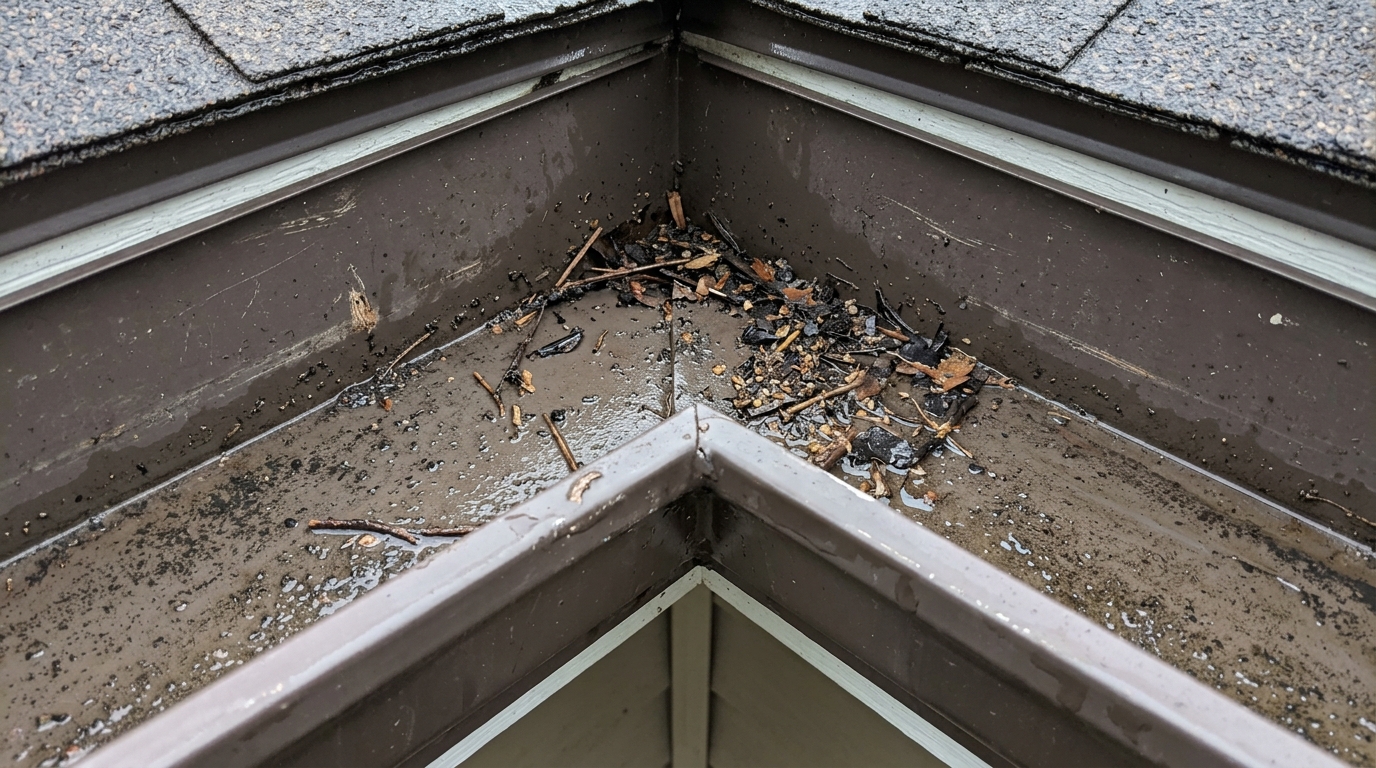
The smooth continuous curve has no interior corners for debris to lodge in. Water moving through carries grit and small leaf matter along instead of leaving it in a crease. K-style’s inside angles are exactly where sediment accumulates, and that accumulation is what eventually holds moisture against the metal.
Greensboro’s tree cover makes this relevant. The Triad’s mature hardwoods drop a heavy leaf load, and neighborhoods with old oaks and maples put more debris on a roof than a newer development does.
Two caveats keep it honest. A half-round packed with wet leaves overflows exactly like any other gutter — easier to clean is not self-cleaning. And half-round brackets can make some gutter guard systems trickier to fit, so if guards are part of your plan, raise that before the profile is chosen rather than after.
There is a durability angle too. Debris that sits in a K-style’s inside corner holds moisture against the metal for days after a rain. On aluminum that mostly means staining; on steel it is where corrosion starts. A half-round that drains completely simply gives that process less to work with, which is part of why old copper half-rounds are still on Greensboro houses a century after they went up.
Do Half-Round Gutters Fit Historic Greensboro Architecture Best?
Yes, and this is the strongest argument for them.
Half-round is the historically correct profile for most pre-war American architecture. K-style is a mid-twentieth-century development, so on a 1920s Craftsman or a Colonial Revival it is visibly wrong to anyone who notices such things — and on the streets where these houses cluster, people do.
There is also a practical dimension beyond taste. Homes in designated historic districts may face guidelines on exterior alterations, and gutter profile and material can fall within them. Check before ordering, not after — Greensboro has several such neighborhoods and requirements differ between them.
Copper half-round on a period home also reads as an upgrade in a way that few exterior components do. It is one of the details that signals a house has been maintained properly rather than merely repaired.
Worth being even-handed, though: the architectural argument runs both directions. On a mid-century ranch, a 1980s colonial, or a newer build in one of Greensboro’s growth corridors, K-style is not a compromise — it is the correct profile for the period, and half-round would look borrowed from a different house. The question is not which profile is better but which one belongs on your elevation.
If you are unsure where your home sits, the honest test is what the original gutters were. On a house that has never been re-gutted, the existing profile usually tells you what the builder intended. On a house that has, look at neighbors of the same era and vintage.
Should You Match Gutter Style to Your Greensboro Roofline?
The roofline should drive the decision more than the wall does, and this is the part most homeowners skip.
Fascia condition and depth matter first. K-style needs a sound fascia board to fasten to. If yours is rotted, that is a repair either way — but half-round’s bracket mounting can be more forgiving of an irregular or shallow fascia.
Roof pitch changes water velocity. A steep roof delivers water fast and can overshoot a narrow trough, which argues for a larger gutter and careful positioning regardless of profile.
Complexity favors K-style on economics. A roofline with many corners, dormers, and short runs means more brackets and more cut pieces on a half-round system, and the cost gap widens with every corner.
Exposed rafter tails are the case where half-round is almost mandatory. On a Craftsman with visible tails, bracket-hung half-round preserves the detail that flush-mounted K-style would hide.
Our guide on how gutters protect your roof, siding, and foundation covers why getting this right matters beyond appearance.
The Bottom Line on Half-Round vs K-Style Gutters in Greensboro
For most Greensboro homes, seamless aluminum K-style is the right answer: more capacity per inch, meaningfully cheaper, faster to install, and appropriate to the architecture of most of the housing stock.
Half-round earns its premium on period and historic homes, on copper installations, on houses with exposed rafter tails, and anywhere the gutter is meant to be a visible part of the design. It is also genuinely easier to keep clear, which counts for something under Greensboro’s tree canopy.
What should not decide it is defaulting to whatever the first quote proposed. If half-round is right for your house, size it up and budget for the brackets. If K-style is right, put the savings into seamless runs and enough downspouts.
If you want someone to look at the roofline and tell you which your home actually calls for, our Greensboro gutter team will measure it and give you both numbers. Schedule a free inspection and we will walk it with you.