Does a Charleston, SC Home Need 6-Inch Gutters?
GuttersBaker Home Exteriors
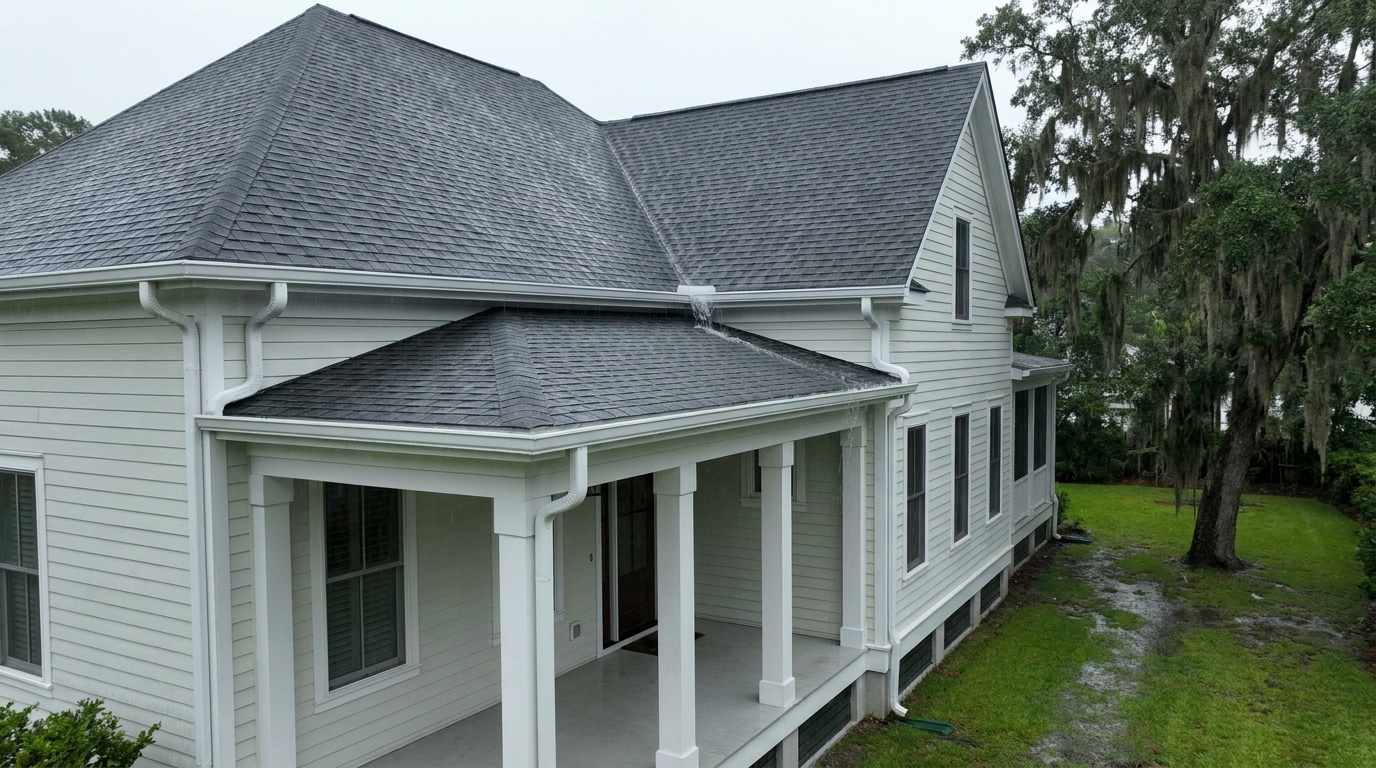
Ask whether a Charleston home needs 6-inch gutters and the honest answer is that it depends on the roof, and on how hard Lowcountry rain falls at its worst. Gutters are sized for the heaviest few minutes of a storm, not for how much rain falls in a year, and here those minutes are intense. Whether your house needs the larger size comes down to three things worth knowing before anyone prices a gutter replacement: how much roof drains into each run of gutter, how steep that roof is, and whether the downspouts can let water go as fast as the gutter catches it.
When Does a Charleston Home Need 6-Inch Gutters Instead of 5-Inch?
Our guide to how gutters protect your roof, siding and foundation sets the starting point: most homes use 5- or 6-inch gutters, and "roof size, slope, and rainfall patterns determine the best size." In Charleston, the rainfall pattern is the part that tips the answer.
What a gutter has to handle is the rate of rain, not the total. For downtown Charleston, NOAA's Atlas 14 precipitation-frequency estimates put the heaviest five minutes you would expect about once every 10 years at about 0.8 inch of rain, a pace of 9.5 inches per hour, and the heaviest hour for the same return period at about 3 inches. The burst runs about three times faster than the hourly pace, and it is when a gutter either keeps up or spills over its front edge.
Set that rate against your roof and the answer usually sorts itself out. A 6-inch gutter earns its place when:
- a large roof plane drains into a single run of gutter;
- the roof is steep, or a valley pours two roof planes into one corner;
- a clean 5-inch gutter still spills over in a hard storm;
- the downspouts can be upsized to match.
A 5-inch gutter still makes sense on small, low-slope roof planes with short runs that aren't overflowing today.
What Roof Size and Pitch Signal a Need for 6-Inch Gutters in Charleston?
A Gutter Supply guide to measuring and pricing gutter installations reduces sizing to a single calculation. It multiplies the roof area that drains into a gutter by a roof-pitch factor and then by the local rainfall intensity, which it describes as the most rain your location might get in a five-minute period. The result is an "adjusted square footage." A 5-inch K-style gutter suits totals up to 5,520; a 6-inch is required above that, up to 7,960.
Pitch enters as a factor because, as This Old House's sizing guide puts it, steeper roofs shed water faster and can collect more wind-driven rain. Its table runs from 1 for a flat to 3-in-12 roof, through 1.05 for 4- to 5-in-12 and 1.1 for 6- to 8-in-12, to 1.2 for 9- to 11-in-12 and 1.3 for 12-in-12 or steeper.
At NOAA's downtown Charleston rate of 9.5 inches per hour, a 5-inch K-style gutter on a roof pitched at 3-in-12 or less reaches its 5,520 rating at about 580 square feet of roof (5,520 divided by 9.5), and a 6-inch reaches its 7,960 at about 840. On a 6-in-12 roof, the 1.1 factor trims those to about 530 and 760 square feet. That is per run of gutter, meaning the roof area that drains into it, not the size of the house.
Those figures describe a once-a-decade burst, so a gutter sized below them won't overflow in every storm, only when the rain comes down faster than it can carry. They do explain why a 5-inch gutter under a long, deep roof plane can spill over in a hard storm even when it's clean.
Published figures don't all agree. The Copper Development Association's Copper in Architecture Design Handbook (2024) lists Charleston's five-minute rate at 7.2 inches per hour for storms likely to be exceeded once in 10 years, below NOAA's 9.5 for downtown. A size worked out from the lower figure comes out smaller, so ask anyone proposing a size which rainfall figure it rests on.
Area and pitch aren't the whole picture. This Old House's guide notes that valleys, where roof planes meet, can send a large volume of water to a single point even on smaller roofs, and that those zones often require extra capacity or additional downspouts. A run that catches a valley can need 6-inch even where the plane-by-plane arithmetic says 5.
How Can You Tell a 5-Inch Gutter Is Overwhelmed by Charleston Downpours?
The test in our gutter guide is the place to start: if gutters overflow during moderate rain despite being clean, they may be undersized for the roof area or the local rainfall. In Charleston, the heaviest part of a hard storm deserves a second look too, because that burst is the rate the arithmetic above is built on. A window or a covered porch is the place to watch from; a ladder in a thunderstorm is no place to diagnose a gutter.
Clean matters, because a clog, a sag or a poor pitch can all pass for a size problem. Water still sitting in the trough well after the rain stops points to the slope or a blocked outlet. Overflow at one spot beside a downspout that's barely running points to the downspout. Those are repairs, not reasons to upsize.
A gutter that is simply too small gives itself away by where and when it spills:
- At an inside corner or below a valley, where two roof planes empty into the same few feet of gutter.
- On a long run that empties into a single downspout, where one stretch of gutter carries the whole plane's water.
- Only in the hardest minutes of the storm, settling back inside the gutter as the rain eases and draining normally once it stops.
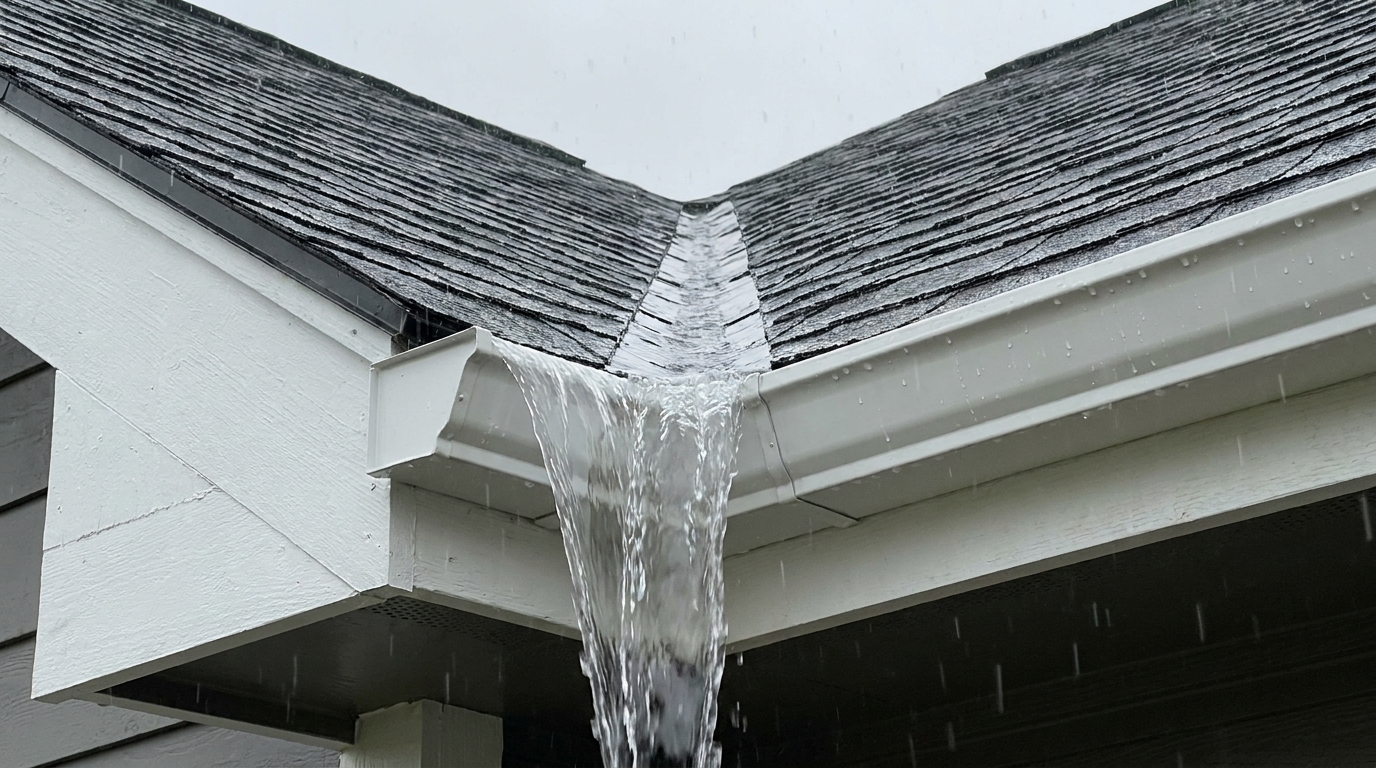
If you missed the storm, the ground keeps a record. Overflow falls from the gutter's front edge, so it wears a line into the mulch or bare soil directly below the lip, away from where the downspout lets out. A line like that beneath a clean gutter is worth pointing out to whoever looks at the system.
Do 6-Inch Gutters Fail Without Larger Downspouts on Charleston Homes?
They don't fail outright, but a bigger trough can only empty as fast as its outlets allow. My Gutter Doctor, a gutter contractor in Frederick, Maryland, pairs 5-inch gutters with 2-by-3-inch downspouts and 6-inch gutters with 3-by-4s in its comparison, and says the larger outlet a 6-inch system typically uses gives about 50% more drainage area than the standard 5-inch outlet.
This Old House's rule of thumb is about 1 square inch of downspout for every 100 square feet of roof, which works out to about 600 square feet for a 2-by-3 downspout and up to 1,200 for a 3-by-4. Hang a 6-inch gutter on 2-by-3 outlets and the trough can hold more water than the outlets can let go.
In Charleston that matters twice: once for the rain rate above, and again under trees, where the outlet has to pass leaves as well as water. How many downspouts a run needs, and where the water should go once it reaches the ground, is its own question; our guide covers it under downspout placement and extensions.
Are 6-Inch Gutters Too Big to Look Right on an Older Home?
Not necessarily, but an older house gives the difference more places to show. A 6-inch K-style is deeper as well as wider, and on the 1940s and '50s brick cottages and ranches in neighborhoods like Byrnes Downs and Avondale, low eaves put the gutter close to eye level.
The board behind the gutter is a better guide than the number in its name. Holda Construction, a gutter installer in Palatine, Illinois, says fascia boards commonly run 5.25 to 7.25 inches tall and that a 6-inch gutter stands about 5 inches tall, often matching proportions better than a 5-inch, especially on newer homes with larger fascias. On an older house with a slimmer fascia or a detailed trim board, the bigger gutter can hide more of that trim than you'd like. The gutter's face and the board behind it are easy to compare from across the street.
On a small facade, the downspouts may be the bigger visual change: a 3-by-4 runs the full height of the wall, while the gutter shows only its face.
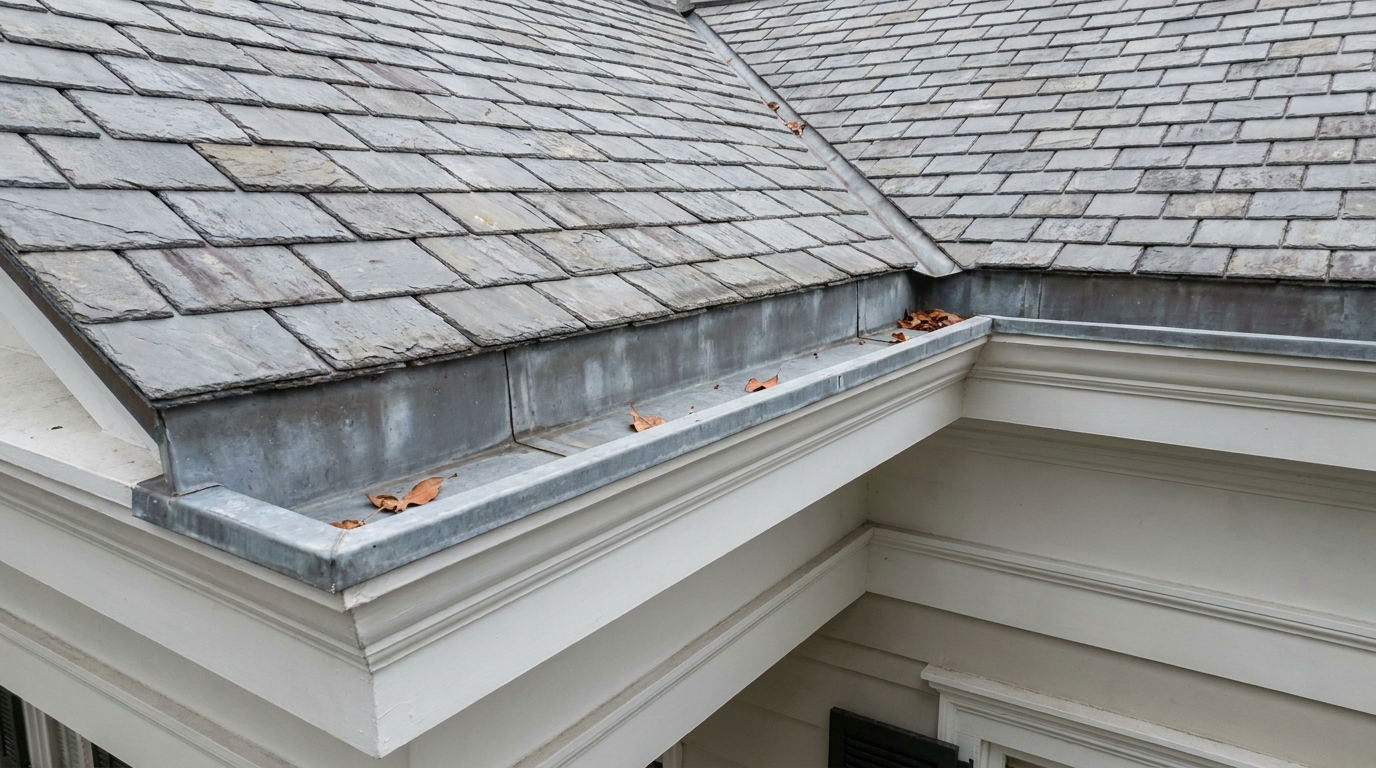
Some of Charleston's older houses have no hung gutters at all. If yours has built-in box gutters behind the cornice, or sits in one of the city's historic districts, our guide to box gutter costs on Charleston homes covers both.
Do 6-Inch Gutters Need Cleaning Less Often Under Charleston Live Oaks?
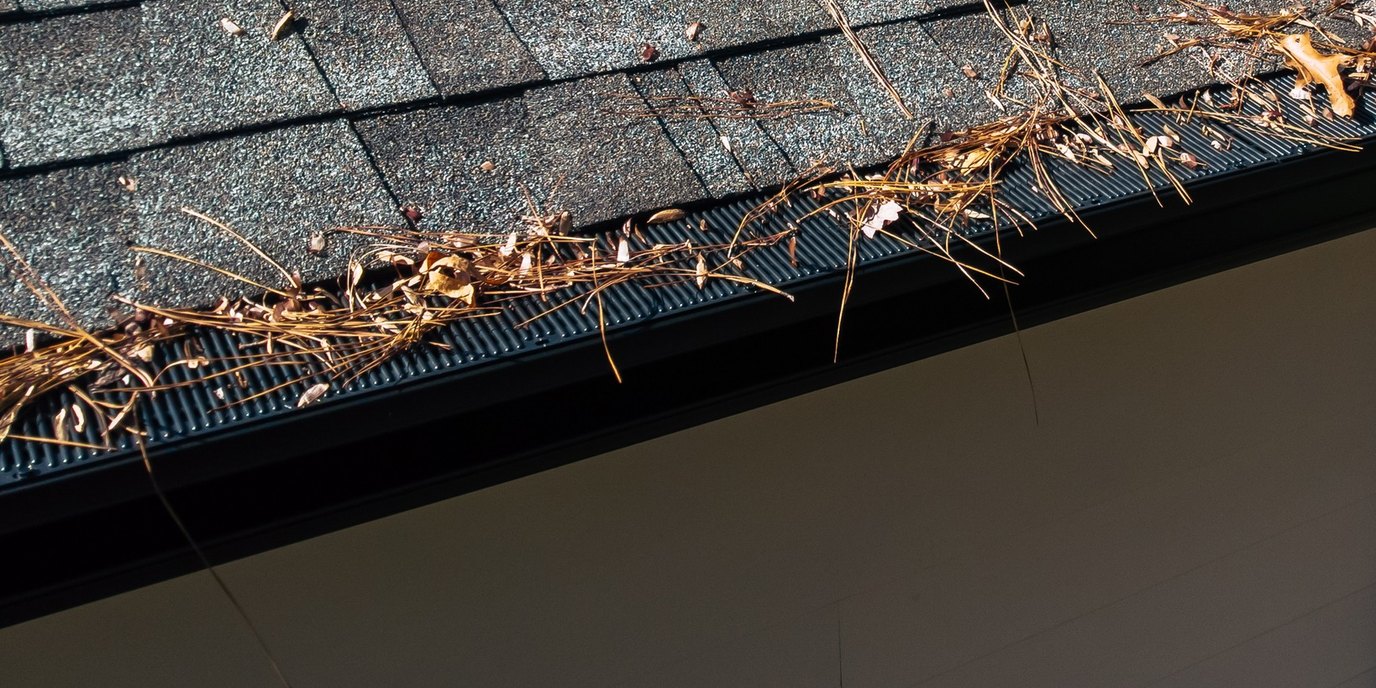
Not reliably. A bigger gutter holds more before it spills, but it catches the same leaves. Under live oaks the leaf drop comes in spring: Clemson Extension's Home & Garden Information Center says live oak leaves remain on the tree through the winter, then yellow and drop as new leaves expand in the spring, though trees growing farther inland become semi-evergreen and lose some leaves in fall and winter.
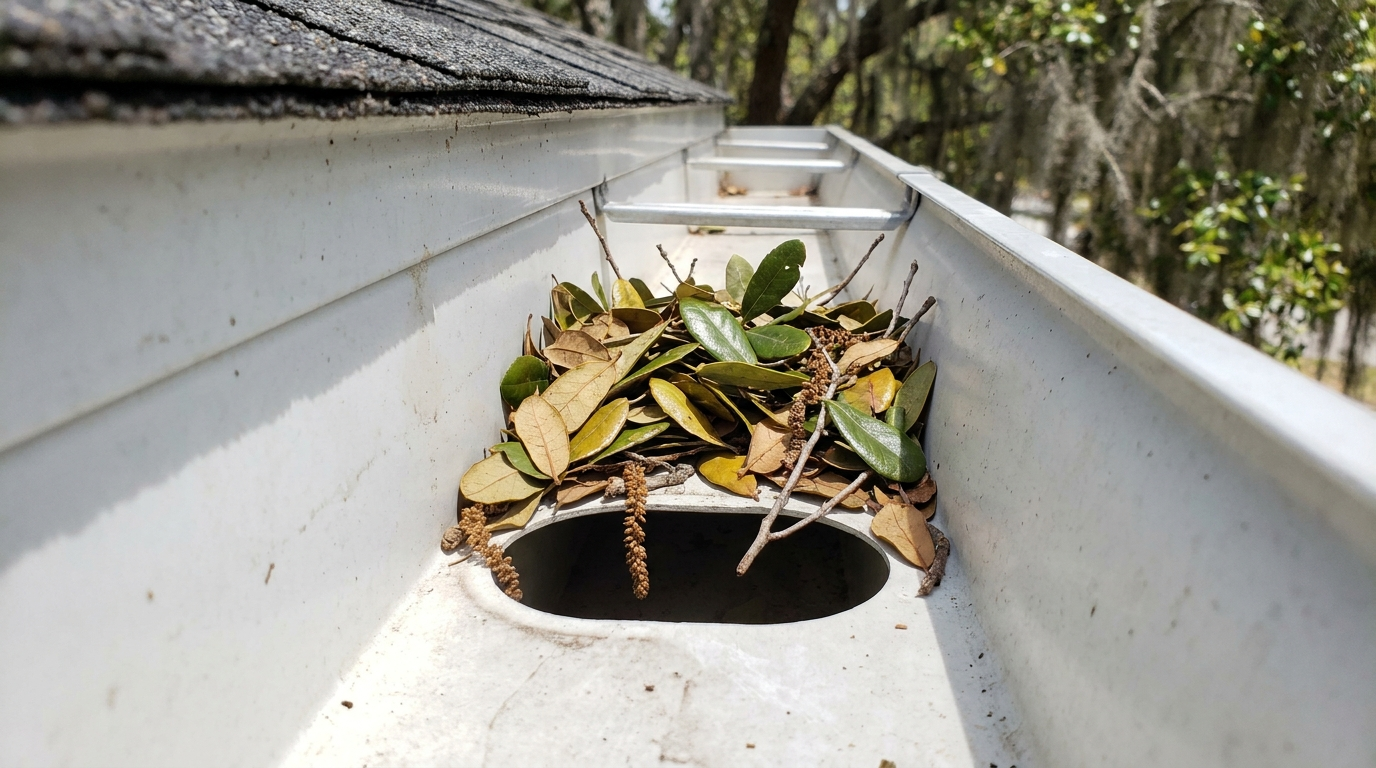
Where 6-inch does help is at the outlet. My Gutter Doctor says the outlet is where most clogs begin, and that larger 3-by-4 downspouts let debris travel more freely through the vertical run and the elbows, which it calls the most common clog points. It is just as clear that upsized gutters still need seasonal cleanings; what drops is the chance of a clog in between.
One homeowner's experience shows both the appeal and the catch. In a Reddit thread asking whether 6-inch gutters are worth it, a homeowner who had added 6-inch gutters and downspouts said they don't clog and haven't needed cleaning. Asked about gutter guards, the same homeowner said they have those too and can't tell which one keeps the clogs away.
So plan on cleaning either way. Under live oaks, time one cleaning for just after the spring drop, and let the fall drop from your other trees set the rest of the calendar.
When Is Upsizing to 6-Inch Gutters Worth the Cost for Charleston Homeowners?
The size step is one of the smaller lines in a gutter job. In a gutter installation cost guide dated October 28, 2025, HomeGuide puts installed gutters at $12 to $25 per linear foot and says 6-inch gutters add $1 to $2 per linear foot. On the 100 to 200 linear feet it says most homes have, that's roughly $100 to $400 more. Those are cost-guide figures, not Charleston quotes and not our pricing.
Whoever quotes the job, ask to see both sizes priced side by side, each with matching downspouts. Our quotes come back written, with options.
Upsizing earns its premium when:
- You're replacing the gutters anyway. The size is set once; changing it later means buying the gutters again.
- The arithmetic or the overflow test points to it: a roof plane past the 5-inch figures above, a run under a valley, or a clean gutter that spills in hard rain.
- The overflow lands somewhere that matters, such as a doorway, a walkway, porch steps or a foundation wall.
- Outlet clogs keep coming back under heavy tree cover, and the larger downspouts are part of the upgrade.
It's harder to justify on small, low-slope planes with short runs that don't overflow when clean, or when the real problem is a clog, a sag or the pitch. And if the fascia behind the gutters has gone soft, that repair comes first, whatever size goes up.
If you'd like to talk through your own rooflines first, our Charleston team is a good place to start.
A Quick Recap
- NOAA's Atlas 14 estimates put the five-minute burst downtown Charleston can expect about once every 10 years at a pace of 9.5 inches per hour, about three times the hourly pace for the same return period.
- At that rate, by Gutter Supply's method and This Old House's pitch factors, a 5-inch K-style gutter reaches its rating at about 530 to 580 square feet of roof per run on roofs up to 8-in-12, and a 6-inch at about 760 to 840.
- Rainfall figures differ: the Copper Development Association's handbook lists Charleston at 7.2 inches per hour for storms likely to be exceeded once in 10 years, so ask which figure a proposed size rests on.
- A clean gutter that spills in moderate rain, or in the hardest minutes of a storm, may be undersized, especially at a corner below a valley; standing water afterward points to the slope or a blocked outlet instead.
- Match 6-inch gutters with 3-by-4 downspouts; on 2-by-3 outlets, the bigger trough can hold more water than it can let go.
- Under live oaks, time a cleaning for just after the spring leaf drop. Larger outlets and downspouts cut the chance of a clog between cleanings, but upsized gutters still need seasonal cleaning.
- In HomeGuide's cost guide dated October 28, 2025, 6-inch adds $1 to $2 per linear foot, or roughly $100 to $400 across 100 to 200 linear feet; those figures are HomeGuide's, not our pricing.
Size the gutter to the burst, and the downspout to the gutter.