Drone vs Walk On Roof Inspections in Asheville, NC
RoofingBaker Home Exteriors
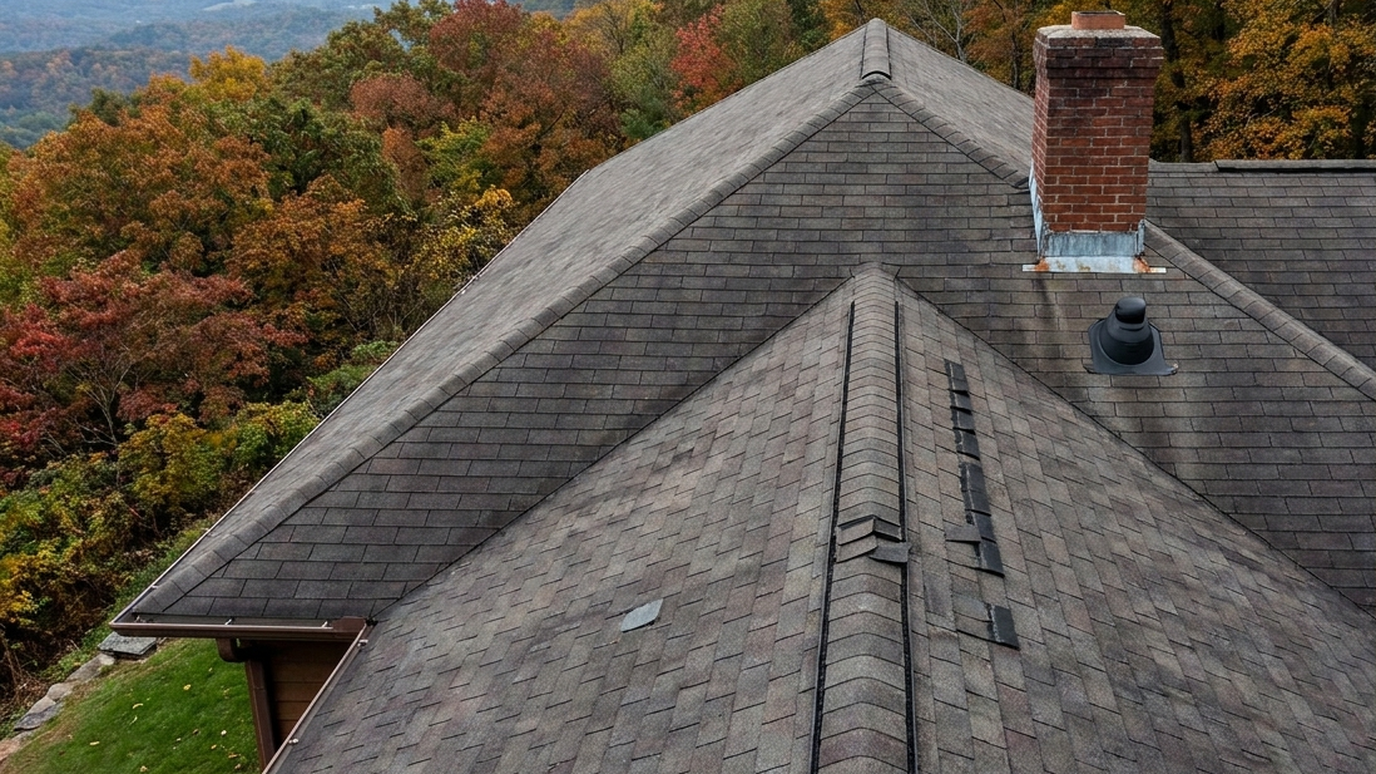
Two roofers look at the same Asheville house. One puts a drone up, circles the roof, and sends over a folder of sharp aerial photographs the same afternoon. The other sets a ladder, walks the slope, then goes inside and climbs into the attic with a flashlight.
The homeowner sees one report arrive fast and one arrive slow, and reasonably assumes the fast one was the modern version of the same thing.
It was not. It was a different surface.
A roof is really three surfaces, and each method reaches a different set of them: the outside seen from above, the outside felt underfoot, and the underside seen from within the attic. A drone is very good at the first. It cannot touch the second or the third. That is not a knock on drones — it is the whole reason the comparison is worth writing down before you book anything, and it is what we walk through on any professional roof inspection in Asheville.
This piece is about method, not about the itemized list of components an inspection covers. That belongs in our action plan for storm and leak damage.
When Should an Asheville Homeowner Order a Drone Roof Inspection?
When the roof is hard to stand on, or when you want a record of it without anyone taking a risk to get one.
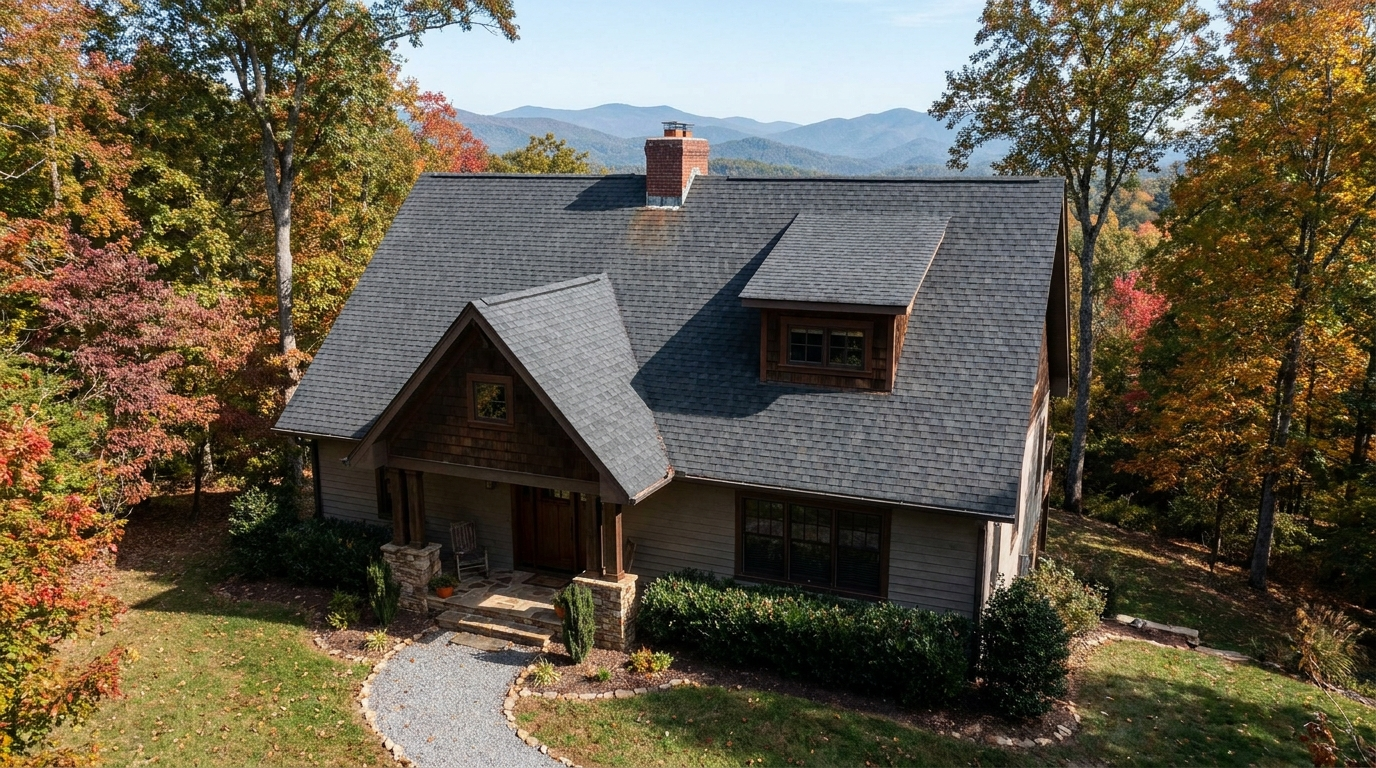
That covers more Asheville houses than you would guess. Homes built into a hillside end up with one eave close to grade and the opposite eave three stories over a drop. Mountain architecture leans steep. Older properties in the coves carry moss on the north plane for most of the year. In all of those cases, a drone is not the lesser option — it is the option that produces usable images without a person on a slick slope.
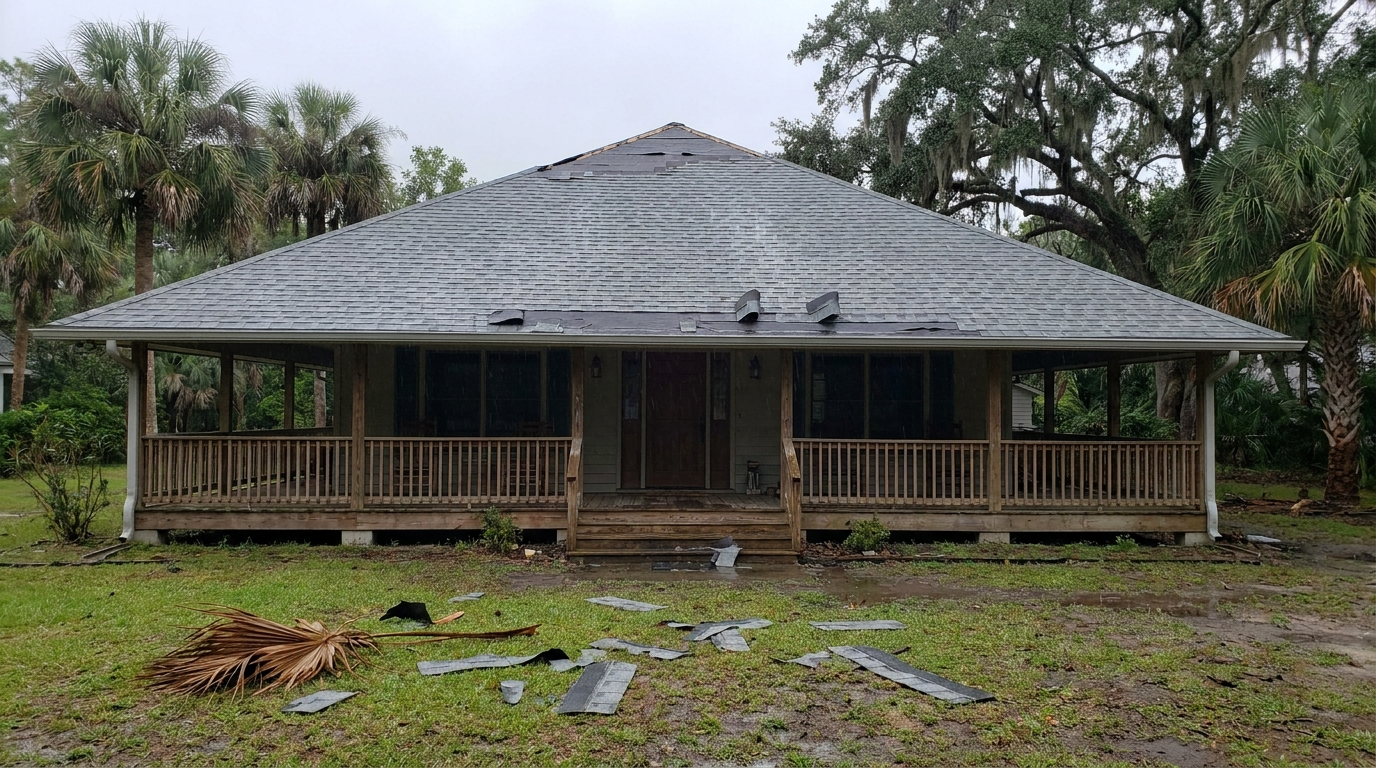
Storm season is the other clear trigger. After a wind event the roof is at its least safe in exactly the days homeowners most want to look at it. Aerial imagery answers the “did something obviously change” question fast, which is worth a lot when a whole neighborhood is asking at once. Anyone flying that drone commercially is operating under the FAA’s small drone rule: as the agency puts it, if you have a small drone under 55 pounds, “you can fly for work or business by following the Part 107 guidelines.”
A drone is also the right first move when you are documenting rather than diagnosing — insurance files, a pre-sale record, a baseline before hurricane season. Photographs from above are excellent evidence.
Where it stops being sufficient is when the question turns from what does it look like to how much life is left in it. That one needs a hand on the roof.
What Can a Drone Spot on an Asheville Roof That a Walk-On Misses?
Geometry, mostly — the things you cannot see because you are standing on them.
From above, a roof reads as a whole system. Damage patterns become obvious in a way they never are from the slope itself: a line of lifted tabs running consistently along one exposure, debris collected in a valley, a ridge that dips. Standing on a roof, you see only a narrow slice of it around you, and you are watching your footing for most of that.
Chimneys and other tall penetrations are the clearest example. One home inspector in an r/HomeInspections thread on this exact question made the point directly, saying that once he had the licensing sorted, he found “things going on with chimneys that walking on a roof or using binoculars would never find.” A chimney crown is above head height from the roof surface and plainly visible from above. The same is true of upper roof planes on a multi-tiered house — the sections a walking inspector reaches by hauling a ladder up behind them, scraping gutters and siding on the way.
A drone can also hold position over a soft spot, an aging cedar roof, or an already compromised section and photograph it closely, where a person putting weight there would cause damage or be in danger.
Thermal deserves a careful note rather than a promise. In one of these threads a commenter with a thermal-equipped drone described being able to see “where heat is escaping from the roof,” which the naked eye cannot. That is real, but it is one operator’s kit rather than a standard feature, and another inspector in the second thread argued the opposite — that the cost of a genuinely accurate thermal camera outweighs the benefit for roof work, and a regular drone evaluates roofs perfectly well. Treat thermal as a capability to ask about specifically, not as something a drone inspection includes.
Which Roof Damage Does a Walk-On Inspection Find First in Asheville?
Some roof damage announces itself underfoot long before it becomes visible from anywhere else, and that is the category a walk-on owns outright.
The most upvoted answer in the r/Roofing discussion on drone-versus-walking inspections — top by a wide margin, from a commenter identifying himself as a roofer — put the case in a single sentence: “The main reason to walk a roof is to get a feeling for the decking underneath.” Deck that has gone soft from a slow leak still photographs as an intact shingle field. It gives underfoot. No camera resolves that, because there is nothing on the surface to resolve.
Shingle condition works the same way. An inspector in the companion thread described the value of being able to “reach down and feel a piece of a shingle to see just how brittle it is” — a roof at the end of its service life often looks acceptable from above and turns out to have shingles that snap rather than flex. Age tells in the hand well before it tells in a photograph. Sealant and fastener integrity are close behind: whether a lap is still bonded or has simply been sitting in place is something you determine by touch.
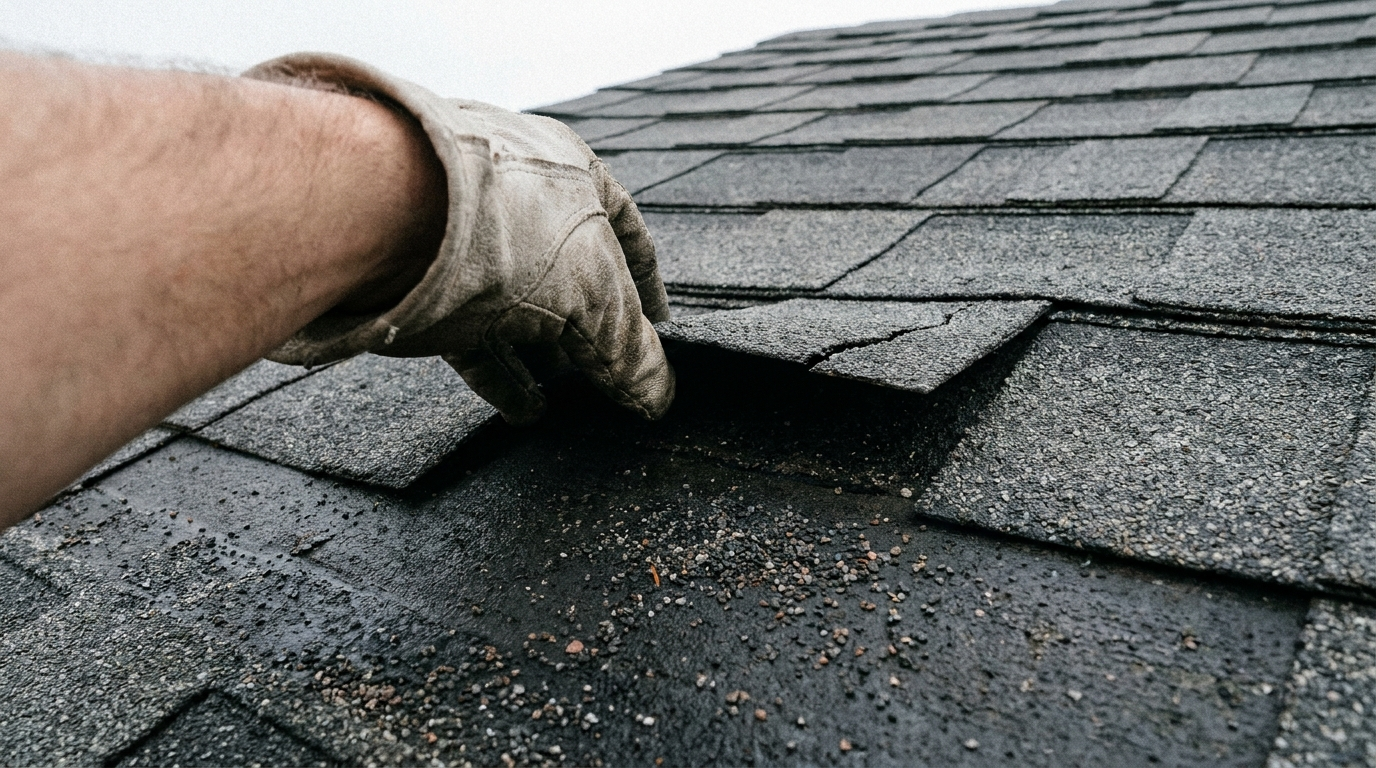
Worth being honest about the same roofer’s qualifier, since it matters: he was arguing that on a straightforward new build with new decking, the walk is not essential, and that he would rather limit his own ladder exposure where the roof does not demand it. The decking argument is strongest exactly where decking is old, which in Western North Carolina housing stock is often.
Hail is its own diagnostic problem with its own ground-level tells, and we have covered how hail damage actually shows up separately.
Why Do Steep Asheville Roofs Need a Drone Instead of a Ladder?
Because past a certain pitch, walking stops being thoroughness and starts being a hazard with no upside.
A working home inspector in one of these threads listed the conditions under which he will not walk a roof, and it maps onto Western North Carolina housing almost line for line: any ice or snow, wet metal, cedar roofs with moss, “steeper roofs with excessive moss buildup,” 8/12 pitch and above, metal above 6/12, three-story houses, multi-tiered roofs requiring the ladder to be pulled up behind you, and soft or muddy ground that makes the ladder itself unsafe. His summary was blunt — safety comes first, and there are plenty of situations where a drone is sufficient.
Asheville supplies most of that list at once. Steep pitches are the regional norm rather than the exception. Hillside lots produce the muddy, sloped ladder footing he describes. Shaded coves grow the moss. Winter brings the frost that makes an early-morning roof treacherous in a way it does not look from the driveway.
The rules also constrain who can do this. Flying commercially requires an FAA Remote Pilot Certificate, which means passing an aeronautical knowledge test and keeping that knowledge current with recurrent training. It is a real credential, and it is a fair thing to ask about. Airspace is a practical limit too — one inspector noted that near an airport the aircraft may simply refuse to fly, which around any regional field is worth confirming before the appointment rather than during it.
None of that makes the aerial pass a complete inspection. It makes it the safe way to see the outside of a roof nobody should be standing on.
Can a Drone Inspection Tell an Asheville Homeowner the Attic Is Dry?
No. This is the single most important limitation, and it is the one most likely to be glossed over.
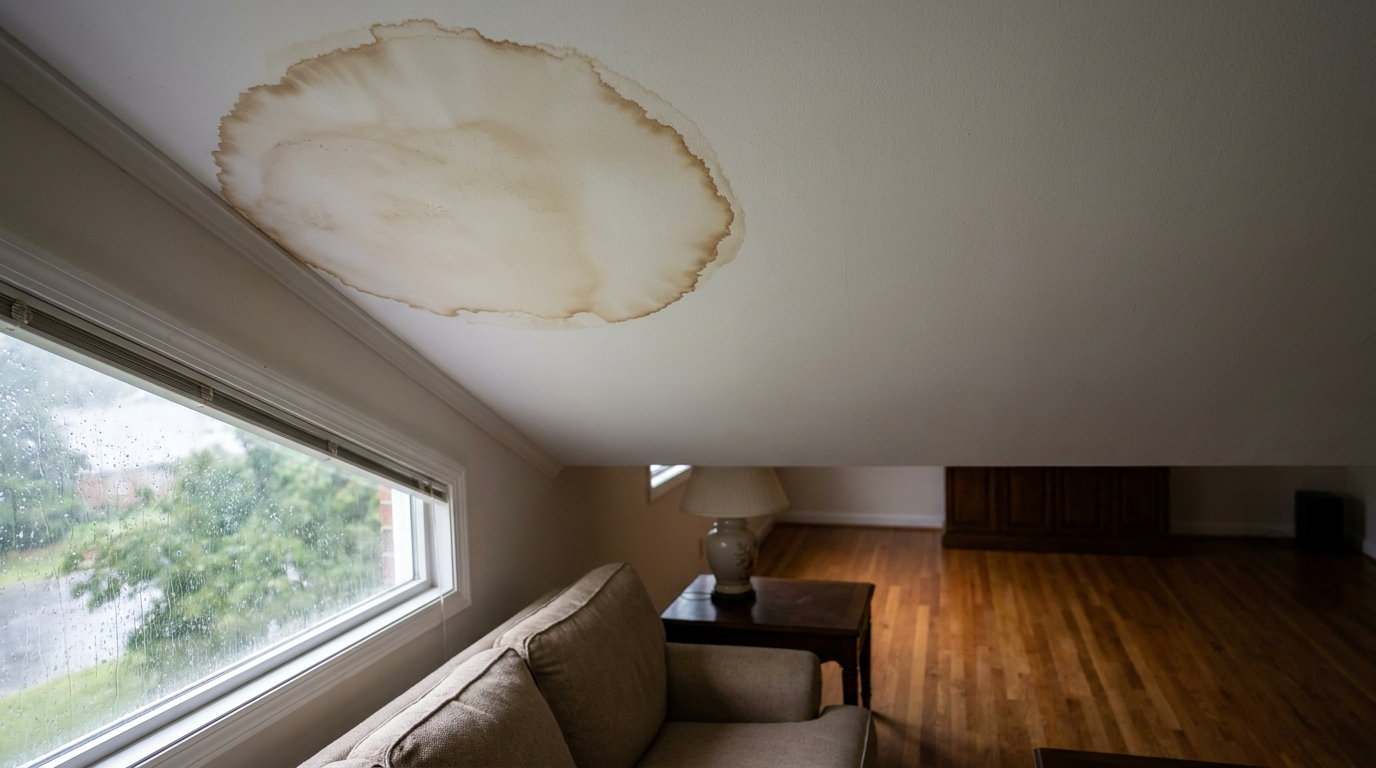
A drone photographs the top of the roof. Water problems announce themselves on the underside of the roof deck, and frequently they show up there first. The Department of Energy’s guidance on durable attics lists what to look for when moisture is getting in, and every item is an interior observation: “Wet insulation in the attic, especially near the eaves,” “Mold or mildew on attic surfaces,” “Warped or rotting wood in the attic.” A camera in the air cannot see one of them.
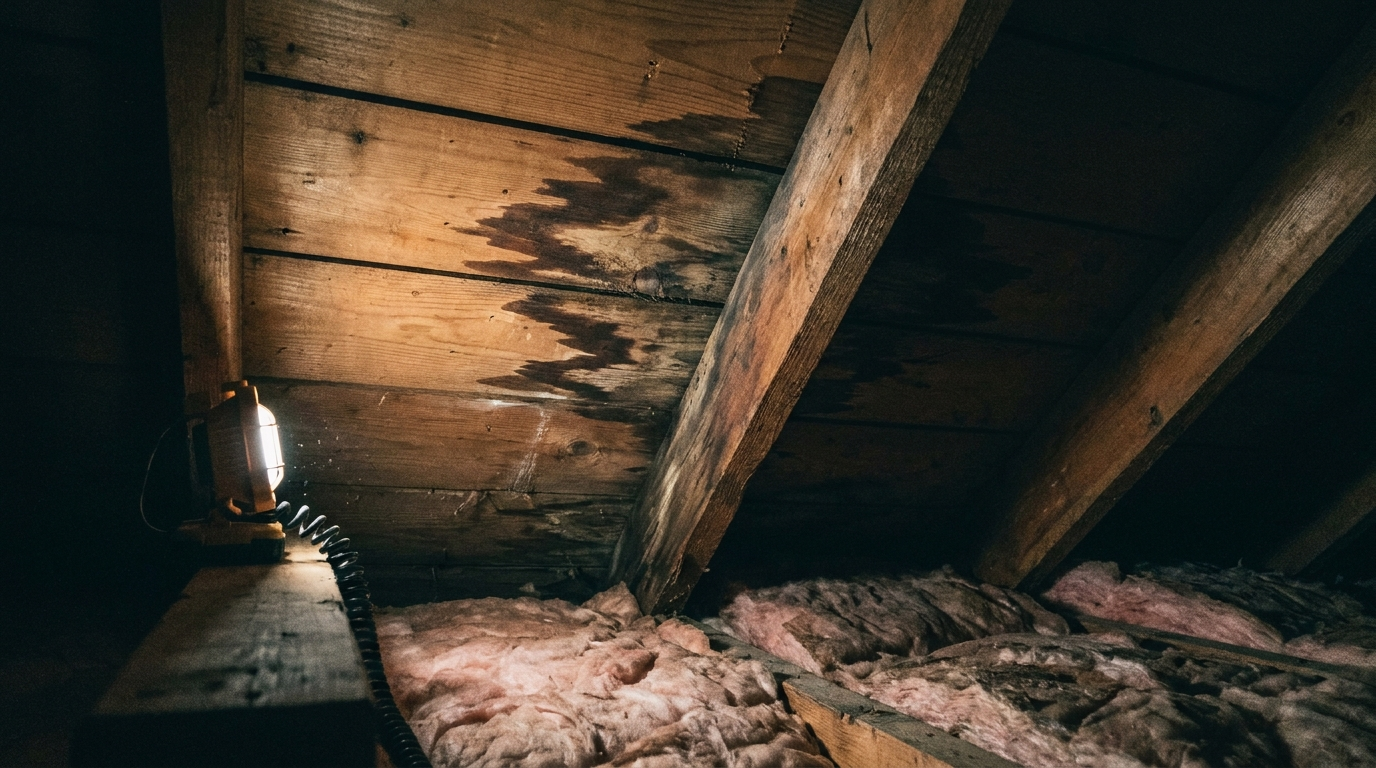
That is why the framing that matters is three surfaces rather than two. Air gives you the overview and the unreachable spots. The roof surface gives you decking feel and material condition. The attic gives you whether water is actually getting in and what it has already done. A drone-only inspection covers roughly the first of those three. It is a genuine and useful third — it is simply not the whole.
One high-volume inspector in these threads, who runs about ten inspections a week and uses his drone on roughly half of them, described his sequencing in a way that gets at this exactly: the roof is the last component he inspects, always after the attic, and he emphasized that this matters especially when flying. The attic tells you what to go looking for. Reverse the order and you are photographing a roof without knowing which part of it to photograph closely.
Our own approach resolves this by not choosing: we walk the roof where it is safe to walk and we open the attic afterward, and you get imagery of both. The specifics of what that visit covers sit on our inspection page. The point here is only that if a proposed inspection stops at the aerial pass, one of the three surfaces has gone unexamined — and it is the one where a slow leak shows up earliest.
How Long Does a Drone or Walk-On Roof Inspection Take in Asheville?
The honest answer splits in two, because the flight is the quick part and the work after it is not.
Operators in the drone-inspection field put a typical residential flight at roughly thirty to sixty minutes, with a simple, compact roof closer to twenty and a large or complicated one running to ninety. That window covers setup, an airspace check, the systematic passes over each plane, and closer manual shots of features like chimneys.
The flight is not the deliverable, though. Reviewing the imagery is the slower half — the same practitioner who inspects ten roofs a week noted that using the drone makes his report take longer, because he prefers to go through the captured roof on a desktop screen rather than call it on site. The same operator guidance that sets those flight windows treats image review and annotation as a multi-hour task, with finished reports commonly delivered within a day.
A walk-on runs differently. Time on site is longer, because it includes the ladder work, the roof itself, and then the attic, but far more of the assessment happens while the inspector is standing there. Add the attic and you are realistically looking at a longer visit than a flight.
Which is the honest way to read the speed comparison: a drone shortens the time someone spends on your property. It does not shorten the work, and it does not compress three surfaces into one. If the roof is steep enough that a walk is genuinely unsafe, that trade is clearly worth making. If it is walkable, choosing the aerial pass for speed alone means paying for a faster answer to a narrower question.
The Bottom Line on Drone and Walk-On Roof Inspections in Asheville
Drones earned their place. They see whole-roof geometry, they reach chimney crowns and upper planes safely, and they document a roof nobody should be standing on — which around here is a real share of roofs, especially after a storm.
What they do not do is replace the two surfaces they cannot reach. Decking that has gone soft is found underfoot. Water getting into a house is found in the attic. The practitioners who do this daily are fairly consistent on the point: walking is preferable where it is safe, a drone is sufficient in plenty of situations, and safety decides between them.
So the useful question is not which method is better. It is whether the inspection you are being offered covers the surface where your particular problem would show up. A visible missing shingle after a wind event, a drone answers well. A stain on a bedroom ceiling, or a roof you suspect is simply old, needs a hand on the deck and a look inside the attic.
If you are weighing a drone or walk on roof inspection on an Asheville home — or you have aerial photographs and want to know what they are not showing you — our Western North Carolina roofing crews are glad to take a look, and to say plainly which parts of the roof still need a closer visit. Storm seasons here have taught us the difference matters; what we learned through Helene shaped how we approach it. Where an inspection turns up something that needs attention, our Asheville repair work starts from what the inspection actually found.